The Summer Reading List Your College Kid Will Actually Use
title: “6 Best Kindle Books for College Students This Summer 2026”
The Summer Reading List Your College Kid Will Actually Use
There it was again. The Summer Scroll Problem.
My oldest came home from his freshman year with zero plans to read anything that wasn’t a menu or a meme. I had a whole pile of books I wanted to share with him, books I genuinely loved, and every single suggestion landed with a polite smile and a quiet disappearance back to the couch. He’d scroll for four hours straight and then announce he was bored. I’d bite my tongue.
Here’s what I finally figured out: it wasn’t that he didn’t want to read. It was that I kept handing him the wrong book for the wrong mood. A 20-year-old who is quietly anxious about their future doesn’t want a dense history book. A kid who claims they don’t like reading needs something that tricks them into it. And the student who is ready to level up? They need something that respects their time and delivers a real payoff.
One book is not going to hook every mood. But six? Six covers a lot of ground. Here’s how this curated Kindle list gives every college-age reader something they’ll actually open this summer.
This post contains affiliate links. As an Amazon Associate I earn from qualifying purchases, at no extra cost to you!
6 Kindle Books College Students Actually Want to Read This Summer
The Productivity Game-Changer: Small Habits, Massive Results
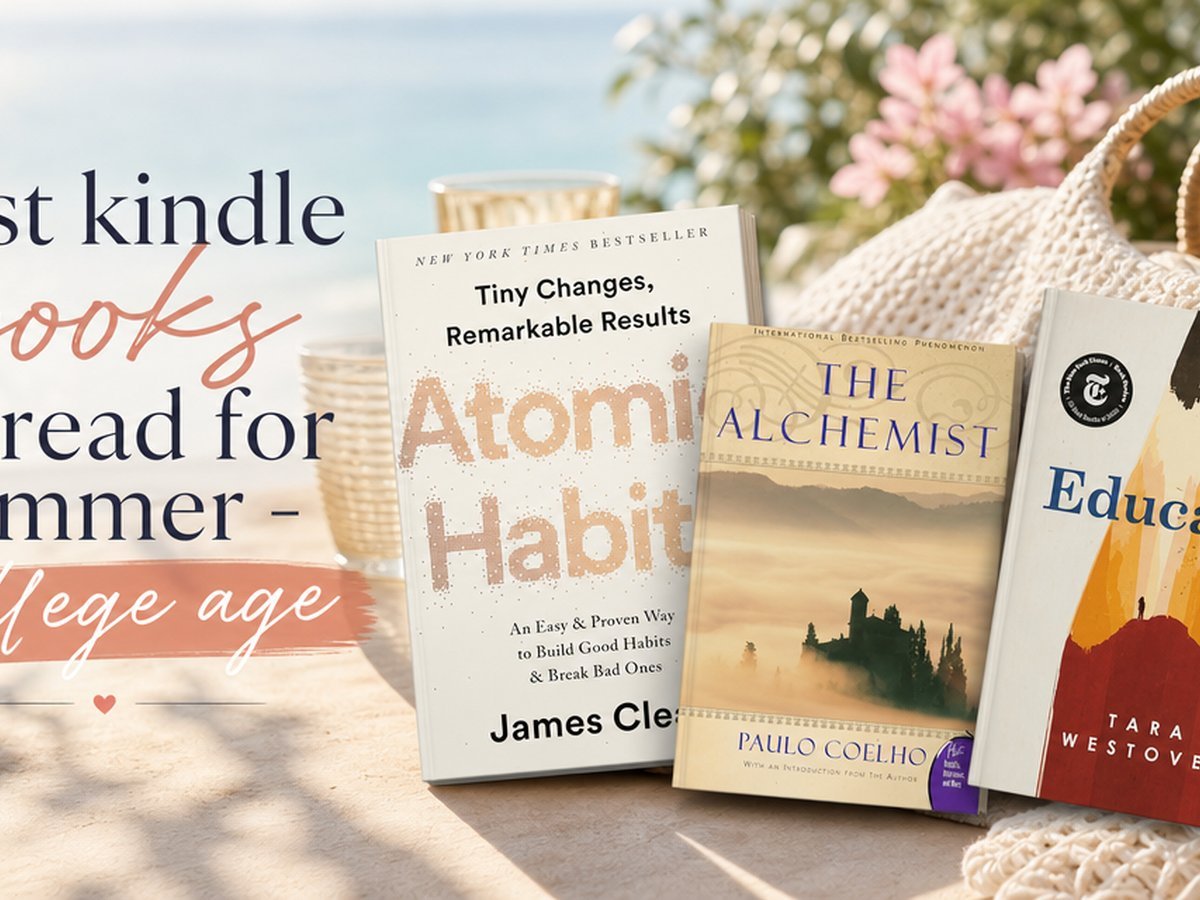
Why we love it: Most productivity books for college students feel like homework. They’re long, heavy, and make you feel guilty before you’ve even cracked the spine. Atomic Habits by James Clear is genuinely different, and that’s not just marketing. The entire premise is that you don’t need to overhaul your life to change it. Tiny changes, done consistently, compound into results that actually stick.
For a college student trying to build adult habits for the first time, that message is a total game-changer. My son’s friend group was passing this one around last semester like it was something they weren’t supposed to have. The chapters are short enough to read in 15-minute stretches between beach trips and afternoon hangouts. It doesn’t feel like reading. It feels like someone sitting down and telling you the shortcut you’ve been missing. I’ve read it twice now, and I still catch myself thinking about the core ideas when I’m trying to build a new routine.
- The win: Teaches lasting habit change without making the reader feel overwhelmed or behind
- The payoff: Short, punchy chapters work perfectly for reading in bursts throughout a summer day
-
The habit-builder: Students who finish this one tend to actually try the strategies, not just file them away
-
Real talk: If your college student is resistant to anything that sounds like self-improvement, they might need a friend to hand this to them before they’ll pick it up. A recommendation from a peer lands about ten times better than one from a mom. Plant the seed, then get out of the way.

Once you’ve got the motivated student covered, there’s still the student who wants something meaningful rather than practical. Something that speaks to the big questions without feeling like a lecture. For that reader, there’s a classic they’ve probably been meaning to finish for years.
The Classic They Keep Meaning to Finish
The Sunday Reset Hero: Every college student has heard of The Alchemist by Paulo Coelho. Most of them haven’t actually read it, and that is genuinely a shame. This book hits completely differently at 19 or 20 than it does at 40, because at 19 or 20 you are actually standing at the crossroads the whole story is about.
It’s a story about following your dream even when the whole world seems to be pulling you in a different direction. A shepherd. A journey. A treasure that isn’t where you thought it was. And it sounds simple when you summarize it like that, but inside those 200 pages there is something that stays with you. My friend’s daughter read it during finals week her sophomore year and said it was the first book that made her feel like her choices actually mattered. Not her GPA. Not her major. Her choices.
The whole book is shorter than most Netflix series, which means it doesn’t feel like a commitment. It feels like a long Sunday afternoon with a story that asks you one good question and then lets you sit with the answer.
- The time-save: Finishable in a single beach weekend, no three-week slog required
- The relief: No complex plotlines to track, no ensemble cast to keep straight, just one beautiful story
-
The game-changer for their summer: Hits hardest exactly when they are figuring out what they actually want from life
-
Fair warning: Students who need plot-driven action will find this too contemplative. It’s symbolic and slow in the most intentional way. Save it for the student who likes to think, not the one who needs to be moving at all times.

With the philosophical reader covered, there’s still the student who says, “I only want to read something true.” The one who finds fiction too easy to put down and too easy to forget. For that reader, a memoir is the move, and this one in particular.
The True Story That Reads Like a Thriller
Why it makes mornings easier: Educated by Tara Westover is the kind of book you pick up and don’t put down, not because you’re trying to read, but because you can’t stop. It’s a memoir about a woman who grew up in a survivalist family in rural Idaho with no formal schooling, no birth certificate, and no real access to the outside world. She taught herself enough to get into BYU. Then Cambridge. Then she earned a PhD. Every word of it is true.
After going down a rabbit hole of book recommendations online last spring, this was the one that kept appearing in every “must-read for college students” thread. The readers who connected with it most deeply were students navigating that exact push and pull between family expectations and their own emerging identity. The writing pulls you in from the first paragraph. You’re gripped immediately. And the themes of education, self-discovery, and finding the courage to choose your own story are deeply resonant for anyone in their early 20s figuring out who they actually are versus who they were raised to be.
- The flow-maker: Reads like fiction, which means it builds a genuine reading habit in a student who thought they didn’t like reading
- The win: Every impossible thing that happens is real, which makes the payoff land ten times harder than any novel could
-
The time-save: No reason to slow down and savor this one, it flies and you let it
-
One thing to know: This book deals with family trauma and abuse, so some chapters are emotionally heavy. It’s not a light beach read. Save it for a student who can sit with difficult material in exchange for one of the most remarkable stories you’ll ever hand them.

Once that memoir lands and they’ve processed everything it brings up, they’ll need something equally gripping but with a little more glamour and a lot more drama. Something where the stakes are still enormous but the world on the page is more beautiful than heartbreaking.
The Romance That Has Real Depth
The After-School Win: The Seven Husbands of Evelyn Hugo by Taylor Jenkins Reid is the book that everyone seems to have read except you, until suddenly you read it and completely understand why it won’t stop being recommended. It’s the story of a fictional Old Hollywood actress who has been married seven times, and the journalist she chooses to tell her whole story to. On the surface, it’s glamorous and dramatic. Underneath, it’s a meditation on ambition, identity, and the price of choosing success over everything else.
My sister-in-law handed this to me last summer and made me promise to read it before she’d let me return it. She was right. The writing is sharp and the story pulls you through every twist without you noticing that you’ve been reading for three hours. College students love this one because it doesn’t talk down to them. The themes are adult and real, and the characters make choices that you genuinely understand even when you know they’re wrong. Once your college student finishes this one, they’ll want someone to talk about it with, which is a win for everyone.
- The payoff: Glamour and drama on the surface, real emotional depth underneath
- The habit-builder: Students who finish this immediately go looking for what Taylor Jenkins Reid wrote next
-
The relief: Big themes handled with such skill that you’re entertained rather than overwhelmed
-
Skip this if: Your college student needs action and plot movement from page one. This is a character-driven narrative that builds slowly. Give it three chapters before deciding, because it earns the early investment in a big way.

Now we’ve covered the motivated student, the philosophical one, the memoir lover, and the drama fan. But there’s still the student who swears they’re just not a reader. The one who needs to be tricked into finishing something. For that student, there is one specific move.
The Page-Turner for the Kid Who Claims They Don’t Read
The Sanity-Saver: Every summer, at least one person in your circle says they’re not a reader. And then someone hands them Where the Crawdads Sing by Delia Owens and three days later they’ve finished it and want to talk about nothing else. I’ve watched this happen more times than I can count.
This book is the one you hand to a self-proclaimed non-reader. It’s part literary novel, part coming-of-age story, part murder mystery, set in the marshes of North Carolina. The pacing is perfect. The characters feel completely alive. And the mystery keeps you turning pages even when you know you should have gone to sleep an hour ago. Thousands of readers who hadn’t picked up a book since high school finished this one in a single long weekend. That’s not marketing. That’s what happens when a book is genuinely impossible to put down. And once they finish it, they often go looking for the next thing. The real win isn’t the book, it’s the reading habit that follows.
- The win: Converts reluctant readers into book people with almost no effort and a lot of payoff
- The game-changer for their summer: A mystery that unfolds slowly enough to be satisfying and fast enough to be genuinely addictive
-
The flow-maker: Once the story locks in, nothing else feels as interesting until you know how it ends
-
The honest trade-off: The setting is rural and historical, which is part of the magic but takes a chapter or two to settle into. Students who need contemporary urban settings may need a little patience at the start. The payoff is completely worth it.

With five moods covered, there’s still one left. The student who is quietly anxious about the future. The one who is asking big questions about their choices and their paths not taken. For that student, there is a book that answers the “am I doing this right?” question in the most beautiful way I’ve ever encountered in fiction.
The Mindset Shift for a Big Summer Question
The Routine Payoff: The Midnight Library by Matt Haig is about a woman who finds herself in a magical library between life and death, where she can explore every version of the life she didn’t live. Every decision she made differently. Every path she didn’t take. It sounds heavy, but it reads as one of the most hopeful books I’ve come across in years.
For a college student standing at the actual beginning of their adult life, this book is deeply comforting in a way that is hard to explain without spoiling it. I spent an afternoon reading through reviews and recommendations before adding this to the list, and the same thing kept showing up in what readers said: the book made them feel better about their own actual lives. Not in a cheap or dismissive way. In a genuine, lasting way. For a 20-year-old who is not sure if they picked the right major, the right college, or the right summer plans, that is not nothing. That is everything.
It’s short enough to finish in a week and meaningful enough to still be thinking about at the end of August.
- The win: Turns the “what if I’m making the wrong choice?” anxiety into genuine peace about real decisions
- The habit-builder: Naturally opens bigger conversations about dreams, regrets, and what actually matters
-
The payoff: Hopeful and thought-provoking in equal measure, the kind of book that makes you feel better rather than worse
-
Real talk: This book opens in a very dark place. If your college student is already going through a hard stretch emotionally, check in before handing it over. In the right headspace it is beautiful. In a fragile moment it needs some context and a warm conversation ready to follow.

The Summer Reading Transformation
Remember the Summer Scroll Problem? The four hours of phone time followed by “I’m bored”? Here’s what changes when you hand them the right book at the right moment.
Atomic Habits catches them when they are ready to grow and gives them a system that works. The Alchemist meets them when they need meaning and a little courage. Educated grips them when they need a true story bigger than their own worries. The Seven Husbands of Evelyn Hugo entertains them deeply and sends them looking for more. Where the Crawdads Sing converts the self-proclaimed non-reader into someone who finishes things. The Midnight Library holds them when they are standing at a crossroads and wondering if they are getting it right.
That’s not just a summer reading list, mamas. That’s a toolkit for your college student’s early 20s: one book for every mood, every question, every summer afternoon. You don’t need them to read all six. You just need to hand them the right one at the right moment. And now you know exactly which one that is.
You’ve got this, mama! Drop a comment below and tell me which book your college student ended up actually reading. I love hearing what lands.
For more ideas your kids will actually love this summer, check out our screen free teen activities guide and our round-up of best kindle books for teens if you’ve got a high schooler at home too!
Don’t forget to pin this article!