The Small Laundry Room Ideas That Make Every Square Foot Count
Our laundry room is barely big enough to turn around in. One wrong step and you are bumping the machines with your hip. The door hits the detergent shelf if you open it too fast. And somehow we need to fit a hamper, all the supplies, a drying rack, and enough room to actually move in a space that a realtor would be generous to call a room.
I spent a long time thinking the answer was a renovation. Knock out a wall, add a closet rod, put in proper built-in shelving. Real solutions for a real problem. What I eventually figured out is that none of that was actually necessary. What a small laundry room needs is not more space. It needs every surface, every gap, and every vertical inch to do a job. Once I started thinking about it that way, six products changed the room completely without moving a single wall.
Here is the thing about a small laundry room: there is more storage potential in it than you think, and almost none of it is on the floor. The gap between your machines? Storage. The back of the door? Storage. The sides of the machines? Storage. The wall at eye level and above? Storage. The goal is to get everything off the floor and off the machine lids, because those are the surfaces that make a small room feel like it’s closing in on you.
This post contains affiliate links. As an Amazon Associate I earn from qualifying purchases, at no extra cost to you!
Six Products That Make a Small Laundry Room Work Like a Big One
Each of these products follows the same rule: it creates more usable space than it takes up. Nothing here earns a place in a small laundry room just because it stores things. Every single one solves a specific small-space problem by using a surface or gap that was already there and completely empty.
The Gap Solution: Turning the Dead Space Between Machines Into Working Storage
What this fixes in a tight laundry room: There is almost always a gap between your washer and the wall, or between your washer and your dryer if they’re not flush. On average that gap is between two and four inches wide. It feels like nothing. It is not nothing. A slim rolling storage cart designed for laundry room gaps fits into that exact space, rolls out for access, and rolls back in so it sits completely flush with the machines. In our room, that gap went from a place where socks fall and never return to a full column of storage holding detergent, stain remover, dryer sheets, lint rollers, and a spare roll of paper towels.
The roll-out feature is the thing that makes this actually usable. A fixed narrow shelf in that gap would be inaccessible. A rolling cart means you pull it out, grab what you need, push it back. The whole interaction takes five seconds. Once it is in, you will not think about it again because it disappears back into the gap but it will be there every time you need something, holding everything that used to live on top of the machines.
- The space win: Turns two to four inches of completely wasted dead space into a full column of vertical storage
- The time-save: Everything rolls to you instead of you reaching around the machines to the back corner
-
The clean-up: Machine lids stay clear because all the supplies have a home that isn’t on top of the machines
-
One thing to know: Measure your gap before ordering. These carts are designed for gaps between roughly 2.5 and 6 inches. A gap wider than 6 inches will feel sloppy and a gap narrower than 2.5 won’t fit any rolling cart regardless of size.

Once the gap is handled, the next best hidden storage in a small laundry room is the one surface almost nobody uses. And it has been right there the whole time.
The Door Hack: Using the One Surface Everyone Forgets
The small-space win: The back of the laundry room door is real estate. In a small room, it might be the only large flat surface you have left. An over-door organizer with shelves and hooks hangs on the door without any mounting hardware, takes up zero floor space, zero wall space, and zero shelf space. And when you open the door, all of that storage opens with it.
I started with a very basic version of this and now I would not go back. Our over-door unit holds the mesh laundry bags, the stain remover pen, a small spray bottle, extra dryer sheets, and the lint brush. Every one of those things used to live on the shelf above the washer, competing for space with the detergent and everything else. Moving them to the door cleared enough shelf space to actually breathe up there. In a small room, that cleared shelf feels like a renovation.
What to look for: a unit with both hooks AND shelves. Hooks alone are good for hanging items but they do not hold bottles or boxes. A combination of hooks for bags and hanging items plus shelves for product bottles is the version that actually transforms the space.
- The win: Adds real storage without using a single inch of wall, floor, or shelf space in the main room
- The habit-builder: Everything that was cluttering other surfaces gets one dedicated door spot that kids and partners can actually find
-
The payoff: The rest of the room feels bigger immediately because it is less visually cluttered
-
Fair warning: Works best on doors that open outward into a hallway rather than inward into the laundry room itself. If your door swings into the room, check the clearance before ordering.

The gap is working, the door is working. The next surface nobody thinks of is right at arm’s reach the entire time you’re loading and unloading: the sides of the machines.
The Machine Upgrade: Side Storage That Appears Out of Nowhere
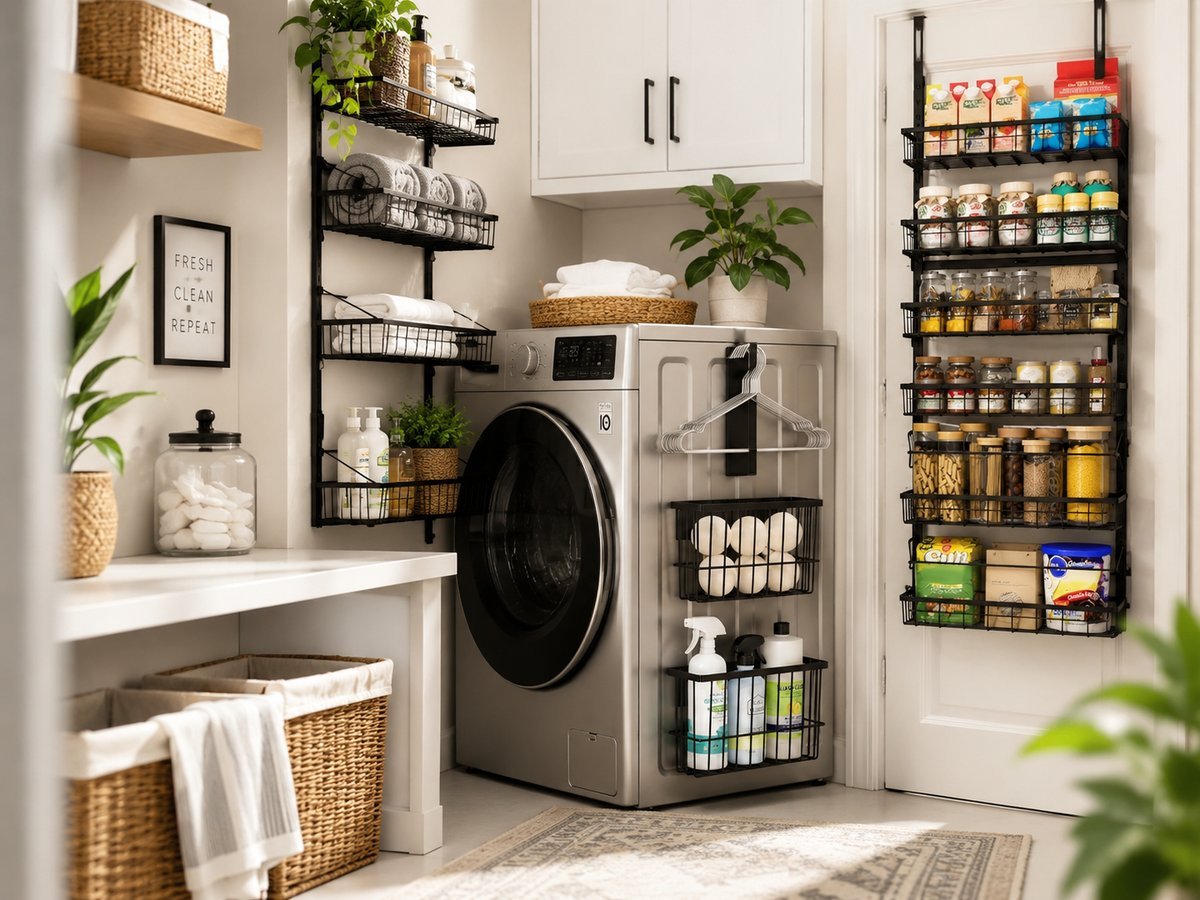
Why this earns its spot: The metal side panels of most washers and dryers are magnetic. That means you have a flat vertical storage surface on each machine that requires no drilling, no mounting, and no wall space. A set of magnetic organizer bins attaches directly to the machine’s side and holds exactly the things you use most: dryer sheets, laundry pods, the lint roller, the stain pen, the spot treatment spray. The items that otherwise end up wherever there is a spare inch of flat surface.
I want to be specific about why this matters in a small room versus a large one. In a big laundry room, a few bottles out of place on the counter is just a counter. In a small room, three items without a home become the thing that makes the whole room feel chaotic. Magnetic bins give every frequently-used small item a designated spot that is literally attached to the machine you are standing next to when you use them. You pick the pod off the machine, put it directly in the drum, put the bin back. No crossing the room, no looking for where you set it down, no reaching over something else to get to it.
- The space win: Creates storage directly on a surface you own but weren’t using at all
- The time-save: Items live exactly where you use them, which removes every step between grabbing and using
-
The relief: Small items stop migrating across the room to wherever there is a spare inch of counter space
-
One thing to know: Magnetic bins work on the side of standard metal washers and dryers. Stainless steel appliances and some front-loaders have weak or non-magnetic panels. Test with a magnet before ordering.

Gap: handled. Door: handled. Machine sides: handled. Now for the walls. This is where a small laundry room has the most untapped potential, and the most common mistake: waiting until there is money for built-in shelving.
The Eye-Level Fix: Floating Shelves That Make the Room Feel Bigger
The space-saving payoff: Built-in shelving is a long-term investment that most renters and many homeowners cannot or do not want to commit to. A set of floating wall shelves closes that gap completely. Two or three floating shelves at different heights above the machines adds multiple square feet of horizontal storage to a room without touching the floor. And because they are mounted at eye level or above, they use the vertical space of the room rather than shrinking the walkable floor space.
The visual effect matters in a small room in a way it does not in a bigger one. Low shelves, tall freestanding units, and floor-level storage all make a small space feel more cramped because they compete with your sight line. Shelves mounted at eye level or above use space you are not already moving through, which means the room feels more open even when it is storing more. I added two floating shelves above our washer and dryer and the room immediately read as organized rather than packed.
For a laundry room, look for shelves with a weight capacity of at least 20 to 25 pounds per shelf if you plan to store full detergent bottles. The standard decorative floating shelf is often rated for lighter loads.
- The win: Adds horizontal storage surface above the machines without floor footprint or visual bulk
- The room-changer: Eye-level and above shelving makes the room read as organized and open instead of cluttered
-
The time-save: No assembly, no freestanding unit to work around, no floor space given up
-
Real talk: Floating shelves require studs or proper drywall anchors. The install takes 20 minutes and a level. Do it right the first time or they will not hold weight reliably.

Walls handled. Now back to the floor. In a small laundry room, the floor is the most expensive real estate you have, and a hamper is almost always the biggest floor-space offender.
The Floor Reclaimer: A Hamper That Takes Up Zero Space When You Don’t Need It
Why this earns its spot: A standard laundry hamper occupies the same floor space whether it is full, empty, or somewhere in between. In a small laundry room, you are paying that floor space cost every single day, even on the six days out of seven when the hamper is sitting empty. A collapsible laundry hamper that folds flat when empty changes that math completely. Open it on laundry day, fill it, move the load to the machine, fold it flat. The floor space it was using comes back to you the moment you empty it.
We tested several versions of this before landing on one we actually use every week. The thing that makes a collapsible hamper work long-term versus one that gets abandoned is the open-to-close ratio: you want it to open fully enough to hold a real load without having to be restuffed, and fold flat enough to actually tuck behind the door or under a shelf. Hampers that fold but only compress by 30 or 40 percent are not saving you meaningful floor space. Look for ones that genuinely flatten to under two inches when folded.
The portable version is also worth considering here. A hamper that is lightweight enough to carry from bedroom to laundry room means it can live in a bedroom or closet instead of the laundry room at all, which frees up the floor completely between uses.
- The win: Returns the hamper’s floor footprint to you every time you empty it, which in a small room is every laundry day
- The space-saver: Folds thin enough to store behind the door, under a shelf, or anywhere else flat when not in use
-
The flexibility: Lightweight enough to live in a bedroom or hallway instead of taking up permanent laundry room floor space
-
Skip this if: You need a permanent designated spot for dirty laundry in the laundry room itself. A fixed hamper does that better. This works best when the hamper’s job is just to transport loads, not to be the ongoing collection point.

You have now handled every quick-win surface: the gap, the door, the machine sides, the wall shelves, the floor. The last move is the one that ties everything together and lets the system adapt as your needs change.
The Wall Grid: Custom Storage That Grows With Your Needs
The room changer: Every piece of storage so far has a fixed shape and a fixed purpose. The slim cart holds a fixed set of items. The door organizer has fixed shelves. The floating shelves hold what fits. A wall-mounted pegboard organizer kit with hooks, bins, and accessories is the one storage solution in a small laundry room that reconfigures itself. You mount one flat board on the wall. Then you arrange hooks for hanging things, small bins for products, a shelf bracket for something heavier, a paper towel holder, a basket. You change the configuration whenever something in your routine changes. Nothing is permanent except the board itself.
This is especially valuable in a small room because the constraints shift constantly. When the kids are little, you store different things than when they are doing their own laundry. When you add a new category of product, there is somewhere to put it without reorganizing everything else. The pegboard does not grow the room, but it grows with the room. I have rearranged ours three times in two years as our laundry routine changed, and each time it took about fifteen minutes.
For a laundry room, look for a pegboard kit that comes with a variety of accessories already included (hooks, bins, a small shelf). Starting from scratch with just a board and buying accessories separately adds up quickly.
- The win: One flat wall panel becomes a fully customizable storage wall that you rearrange instead of replace as your needs change
- The payoff: Hooks, bins, shelves, and holders in one system eliminate the need for separate organizers across the wall
-
The long-game: Zero wasted spend as your routine evolves just move what you have instead of buying something new
-
One thing to know: Pegboard needs to be mounted with spacers behind it so hooks can pass through the holes. Most kits include these. If yours does not, pick up a set of spacers before you mount.

Your Small Laundry Room: The Full Picture
Here is what the room looks like once all six of these are working together. The gap cart handles everything that used to live on top of the machines. The door organizer holds the small-use items that were always getting in the way. The magnetic bins put laundry pods and dryer sheets right at the machine. Floating shelves hold detergent, spare supplies, and folded overflow above eye level. The collapsible hamper comes in for a load and folds away when it’s done. And the pegboard creates a customizable catch-all for whatever your room still needs.
The floor is clear. The machine lids are clear. Every surface is working. The room is still the same size it was before. But now every inch of it is doing something, which is what a small laundry room actually needs.
For more ideas on getting the most out of this space, check out our full laundry room organization ideas guide. And if you’re working with machines stacked vertically, our laundry room stacked washer and dryer post has the vertical-space strategies that work best in that layout.
You have got this, mama! Drop a comment below and tell me which part of your small laundry room is driving you the most crazy. I have probably been there.
Don’t forget to pin this article!