The Garage Organization System That Finally Gets the Car Back Inside
The car has not been in our garage in three years. Every time one of the kids wants a bike, it takes ten minutes of moving things around to reach it. The camping chairs are somewhere on the left side under a bag of potting soil and what I am fairly certain are Halloween decorations from 2022. The sports equipment is in a pile near the door that gets kicked every single time anyone walks in or out. And every few months someone says “we should really deal with the garage this weekend,” and then we close the door and go inside.
The problem is not that there is too much stuff. We actually do not have an unusual amount of garage things. The problem is that nothing has a home. Bikes land wherever they get dropped. Tools get stacked on the nearest flat surface after every project. Sports gear migrates from bag to pile to corner over the course of a season. And seasonal items, the holiday decor and the camping gear and the sports equipment that rotates in and out, go wherever there is a gap, which means they go nowhere useful.
What changed our garage was not a weekend purge. It was six products that each solved one specific storage problem. Once every category of thing had a dedicated zone, the pile-and-forget cycle stopped. The kids can get their own bikes out. I can find a tool in under a minute. The car fits inside again.
This post contains affiliate links. As an Amazon Associate I earn from qualifying purchases, at no extra cost to you!
Six Products That Turn a Chaotic Garage Into a Space That Works
Think of these as zone assignments, not just storage products. The wall gets the bikes and the tools. The ceiling gets the seasonal overflow. The floor zone gets the shelving. The sports gear gets its own corral. When every category of garage stuff has an assigned spot, the chaos stops regenerating itself every two weeks. Here is the system.
The Floor Clearer: Getting the Bikes Off the Ground and Out of the Way
Why this earns its spot: Bikes are the biggest floor-space offenders in most family garages. A single bike lying on the ground or leaning against a wall makes a surprisingly large area completely unusable. Two bikes doubles that. Four bikes, one per family member, can eat an entire parking lane. Wall-mounted bike hanger hooks solve this completely by taking the bikes vertical. Each hook holds one bike by the front wheel or frame, mounted at whatever height keeps the tire off the ground. The floor underneath is completely clear.
The independence factor matters here in a way it does not with most garage storage. When bikes are in a floor pile, kids cannot get their own bike without moving at least one other bike, and usually three other things. When bikes are on dedicated hooks at the right height for each kid, they can get their own bike and hang it back up without asking for help. That one shift removed an entire category of “can you help me” requests from our weekend mornings. My twins can now get to the bikes, ride for an hour, and come back and hang them up themselves. That is worth every penny.
- The win: Recovers the full floor footprint of every bike stored, which in a two or three-bike family is significant floor space
- The independence builder: Kids can access and return their own bikes without help, which removes the adults as a bottleneck for every ride
-
The space-save: Bikes go on the wall, which means the floor below them stays clear for the car, the shelving unit, or just room to move
-
One thing to know: Ceiling height matters. A standard adult bike mounted vertically needs at least 7 feet of wall clearance. Measure before mounting, especially in garages with lower ceilings or sloped walls.

With the bikes off the floor, the next step is creating the central storage structure everything else will organize around. The shelving unit is the backbone that makes every other system possible.
The Backbone: Heavy-Duty Shelving That Holds Everything in One Zone
The organization payoff: In a garage without shelving, things end up in piles because there is nowhere else for them to go. A heavy-duty metal shelving unit with five tiers creates immediate vertical storage in the footprint of one floor section and becomes the anchor for the entire room. Tools, bins, sports bags, paint cans, garden supplies, cleaning products they all need a level surface at a reachable height, and the shelving unit provides that in a way no wall-mounted storage can fully replace.
The weight capacity is what separates a garage-grade shelving unit from the kind sold for closets. Garage shelving needs to hold full storage bins, which can be thirty to fifty pounds each when loaded with seasonal items or hardware. Look for units rated at 200 to 250 pounds per shelf rather than the light-duty versions designed for lighter loads. Metal construction handles humidity, temperature swings, and the kind of use that eventually destroys the MDF shelving people sometimes try to make work in a garage. I went through two sets of MDF shelves before I understood this. The metal unit we replaced them with has not moved, bowed, or shifted in two years of family use.
- The win: Creates five full tiers of storage in one floor section, which is where most of the garage’s capacity actually comes from
- The time-save: Everything has a level, dedicated shelf instead of stacking on the floor where the bottom item is always the one you need
-
The durability: Metal construction handles garage conditions humidity, temperature changes, and heavy loads that destroy lighter shelving materials
-
Real talk: Assembly takes 45 to 60 minutes with two people. The pieces are heavy. Do not try to solo-assemble a large shelving unit in a garage; you will need a second set of hands for the upper tiers.

The shelving unit holds everything that belongs in a bin or on a flat surface. The wall above and beside it is the right place for the second storage system: the one that puts tools where you can actually see them.
The Tool Wall: Finding Every Tool in Ten Seconds or Less
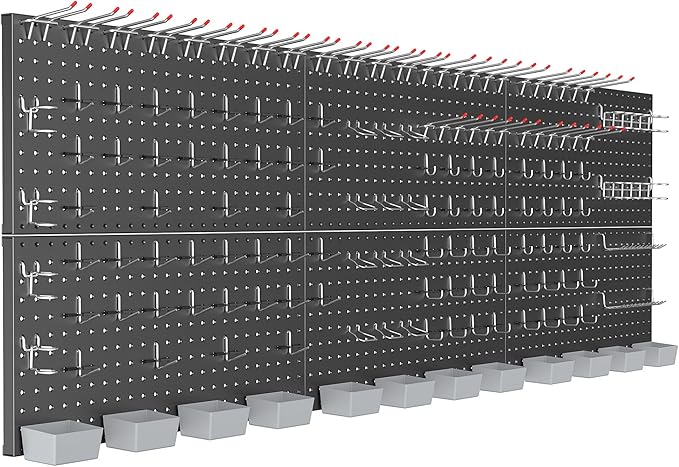
The room changer: There is a version of garage tool storage where everything lives in a toolbox or in a drawer, and you spend five minutes opening drawers until you find the right one. Then there is a version where every tool is visible on the wall, you walk in, you see it, you grab it, you go. A pegboard wall organizer with hooks, bins, and a variety of mounting accessories creates the second version. One flat panel turns a section of garage wall into a fully visible tool inventory that takes ten seconds to scan and five seconds to reach.
The reconfigurability is what makes a pegboard worth the initial install over nailing individual hooks. As your tools change, as you add things or trade out a drill for an upgraded model, the hooks move. You do not drill new holes or leave half the wall with empty nails. The configuration grows with you. For a family garage where the tool collection changes as kids get older and projects get bigger, that flexibility means the system keeps working instead of becoming outdated every few years.
What to look for in a garage pegboard setup: a panel large enough to actually hold your core tools without cramming, a set of hooks in multiple sizes for different tool weights, at least a few small bins for screwdrivers and bits and small hardware, and spacers to mount the panel off the wall so hooks can pass through the holes.
- The win: Puts every tool in visible, reachable order so finding what you need takes seconds instead of minutes of digging
- The flexibility: Hooks and bins move as your tool collection changes, so the layout stays useful instead of going stale
-
The relief: No more opening every drawer in a toolbox looking for the one screwdriver you need
-
One thing to know: A pegboard kit that comes with only hooks gives you a starting point, but you will want to supplement with different hook sizes and a few bins. Budget for the initial kit plus 20 to 30 dollars of additional accessories.
Bikes on the wall. Shelving anchoring the floor zone. Tools visible on the pegboard. The last major untapped resource in most family garages is directly above where the car parks.
The Ceiling Opportunity: Storage Above the Car You Are Not Using Yet
Why this earns its spot: Look up next time you are in your garage. If you are like most families, there is a full zone of completely empty air up there. The ceiling above the car is not being used at all, and it is some of the best storage real estate in the garage because it does not compete with the bikes, the shelving, or the tools. An adjustable overhead ceiling storage rack hangs from the ceiling joists and creates a dedicated zone for exactly the things you need once or twice a year: holiday decorations, camping gear, seasonal sporting equipment, luggage.
The adjustable height feature is the one to look for. Ceiling heights vary by garage, and the clearance between the rack and the car roof needs to be enough to actually park below it. Most adjustable racks can be set from 22 to 40 inches below the ceiling, which handles most standard vehicle heights. The installation takes about two hours and requires locating the ceiling joists, but the result is a platform that holds 300 to 500 pounds of seasonal storage without touching a single wall, shelf, or floor zone.
After I put ours in, the camping gear, holiday bins, and luggage all moved up to the ceiling. That cleared nearly an entire section of the shelving unit, which then held the tools and supplies that used to live in a pile on the floor. One product cascaded into two cleared zones.
- The win: Uses the ceiling above the car, which is the only storage zone in most garages that is completely unused
- The cascade effect: Moving seasonal items to the ceiling frees wall and floor zones for frequently-used gear
-
The capacity: A standard ceiling rack adds 32 to 48 square feet of overhead storage in the garage’s best unused air space
-
Real talk: Installation requires finding ceiling joists and using lag bolts. This is not a 20-minute install. Read the installation guide before buying and make sure your ceiling construction can support the load.

Bikes, shelving, tools, ceiling: the garage’s major zones are handled. What usually brings the whole system down is the stuff that does not fit neatly into any of those zones. The seasonal items, the sports equipment overflow, the things that come and go by season.
The Seasonal Swap: Bins That Make the Twice-a-Year Sort Manageable
The small-space win: Seasonal storage in a garage lives or dies by one thing: whether you can tell what is in each container without opening it. A set of large stackable storage bins with lids gives the garage a consistent system for everything seasonal. Holiday decorations in one bin. Pool toys in another. Winter sports gear in another. Spring yard supplies in another. The lids protect the contents from dust and garage humidity between seasons, and the stackable design builds vertical columns from one floor footprint.
The difference between clear bins and opaque bins is worth thinking through before you buy. Clear bins let you see the contents at a glance from across the garage. Opaque bins hold up better in sunlight and often have a cleaner look if that matters to you. The middle option opaque bins with clear windows gives you some of both. What matters most is that every bin gets a label. Even clear bins benefit from a label because you can read the category name faster than you can visually scan the contents. I use a label maker; a piece of masking tape and a marker works just as well.
The stackable design only works if the stack is stable. Look for bins with lids that have a rim or groove that locks into the base of the bin above it. A stack that shifts every time someone pulls a bin from the middle is not a functional system.
- The payoff: Every seasonal category has its own sealed container so nothing mixes, nothing gets damaged, and nothing requires a full garage sort to find
- The time-save: Stacked labeled bins mean the twice-a-year seasonal swap takes one hour instead of an entire weekend
-
The protection: Lids keep garage humidity, dust, and pests away from stored items between seasons
-
One thing to know: Bins that look similar in photos can vary a lot in actual quality. Check reviews specifically for lid fit and hinge durability. A lid that does not stay closed defeats the whole system.

Seasonal storage covered. The last thing standing between a functional garage and a family that can actually use it is the sports equipment, which in most households is the most frequently accessed and the most reliably chaotic category.
The Sports Corral: One Spot for Every Ball, Helmet, and Piece of Gear
The independence builder: Sports equipment is the category that undoes garage organization most reliably. It comes in constantly from practices and games, it goes out constantly for pickup games and weekend activities, and without a system it lands wherever someone drops it. A wall-mounted sports equipment organizer and ball storage rack creates the sports corral: one zone where every ball, helmet, and bat has a home and kids can access and return gear without involving you.
The key feature to look for is a combination of ball slots and hooks. Ball slots hold the actual balls so they do not roll. Hooks hold helmets, bags, lacrosse sticks, baseball bats, and whatever else your kids play with. A rack that is only ball storage will not hold the full range of equipment. A rack that is only hooks will not contain the balls. The combination units that mount to the wall with both types of storage are what make this work for a multi-sport family. My kids play three different sports between them, and everything fits in one section of the wall that they manage themselves.
The wall-mount style keeps the floor clear, which matters once you are trying to park the car again. A freestanding sports rack is better than no rack, but it takes up floor space and moves around. Wall-mounted stays put, stays accessible, and does not end up in the middle of the garage when someone rolled it out of the way.
- The win: One zone for all sports equipment means kids can find their gear independently before practice without asking you where it is
- The floor-save: Wall-mounted keeps the floor clear for the car and bikes, unlike freestanding rack alternatives
-
The habit-builder: When equipment has a specific slot or hook, putting it back becomes as easy as taking it out, which is the only way the system self-maintains
-
Fair warning: Works best when kids are old enough to reach the hooks and care about putting things back. For very young kids, position hooks and slots at their actual reaching height.

Your Garage: The Full Transformation
Three years since the car was inside. Ten minutes to find a bike. Sports gear in a pile by the door. The seasonal items somewhere under everything else.
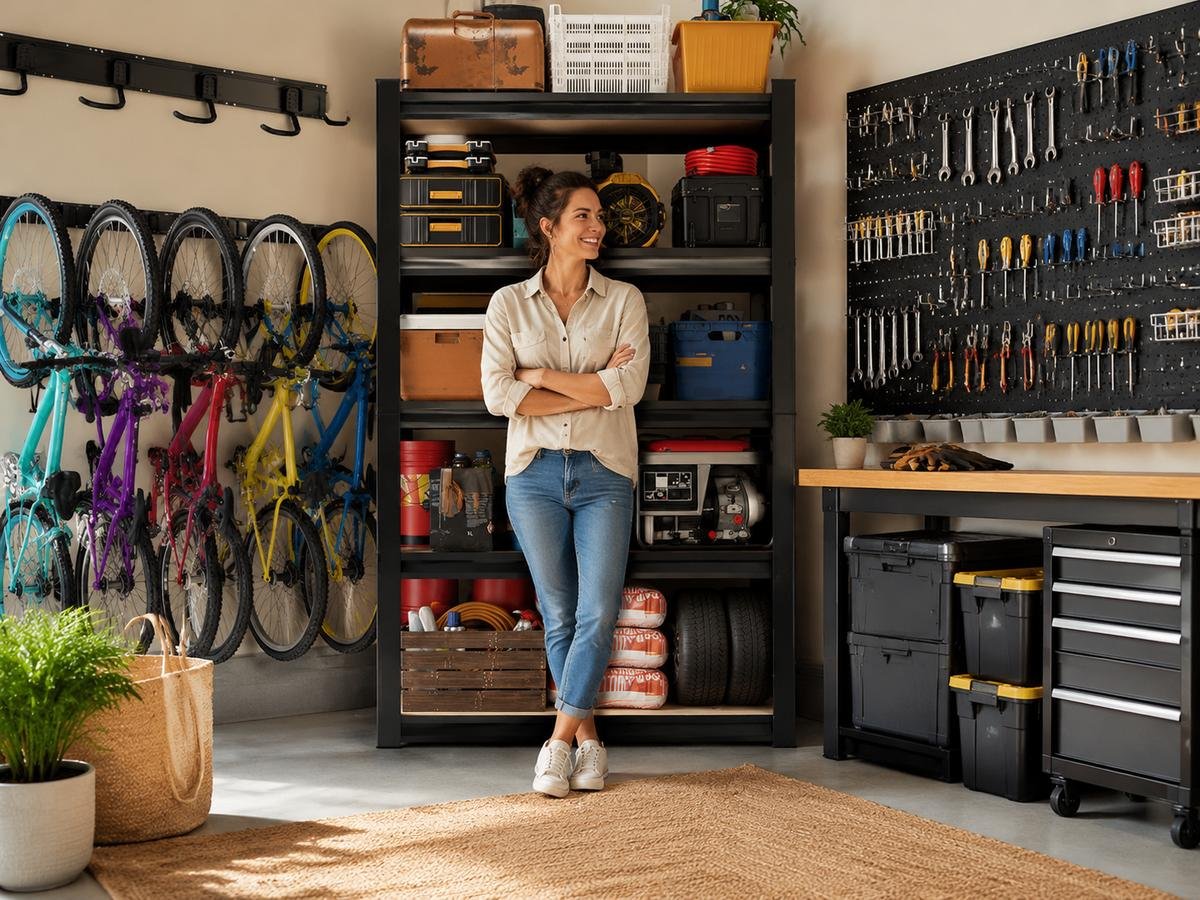
Here is what the garage looks like now. Bikes are on the wall, mounted at each kid’s height, accessible to them independently for the first time. The heavy-duty shelving holds the bins, tools, garden supplies, and everything that needs a level surface. The pegboard keeps tools visible and reachable in seconds. The ceiling rack above the car holds every seasonal item that only needs to come down twice a year. The storage bins give each seasonal category its own sealed, labeled container. And the sports corral gives every ball, helmet, and bat a home the kids can reach and return on their own.
The car fits inside. The kids can get their bikes. You can find the hammer in under a minute. That is what a garage organization system is actually for.
For more home organization ideas, check out our full guide to home organization ideas for moms, and if the laundry room is next on your list, our laundry room organization ideas post has the same zone-by-zone approach for that space.
You have got this, mama! Drop a comment below and tell me what your garage’s biggest problem zone is. I want to know if I missed your specific chaos.
Don’t forget to pin this article!