Kids Summer Activities Worth Adding to Your Rotation This Season
The Summer Boredom Spiral is real, and if you’ve lived it you know exactly what I mean. It was only 9 AM on day three of summer break and I had already heard the phrase “I’m bored” eleven times. Eleven. Before I’d even finished my first cup of coffee. I had big plans for the week: a splash pad trip on Thursday, a library visit on Friday, and a movie afternoon somewhere in the middle. But Thursday was four days away, and right now I had two very energetic twins, one increasingly annoyed middle-schooler, and zero ideas for the next forty-five minutes.
I did what any exhausted mom does. I told them to go outside. They lasted seven minutes. I told them to find something in the playroom. My daughter came back with a board game that was missing half its pieces. My son announced the backyard was “too hot” even though it was seventy-two degrees. I ended up handing them both a tablet and feeling vaguely guilty about it for the rest of the morning.
The problem wasn’t that I had nothing for them. The problem was that I didn’t have a rotation. A reliable set of activities I could pull from on any given summer morning without thirty minutes of planning, setup, or a trip to the craft store. The families that actually survive summer break have a system. A handful of go-to activities that work independently, hold attention for a real stretch of time, and don’t require mom to direct the whole thing.
These six picks are what I’ve built into our summer rotation this year, and they cover every kind of summer day: the hot outdoor days, the rainy inside days, the restless energy days, and the quiet creative days. Here’s how this lineup turns that Summer Boredom Spiral into real pockets of time for you.
This post contains affiliate links. As an Amazon Associate I earn from qualifying purchases, at no extra cost to you!
The Outdoor Water Saver: Cool Down Without the Chaos
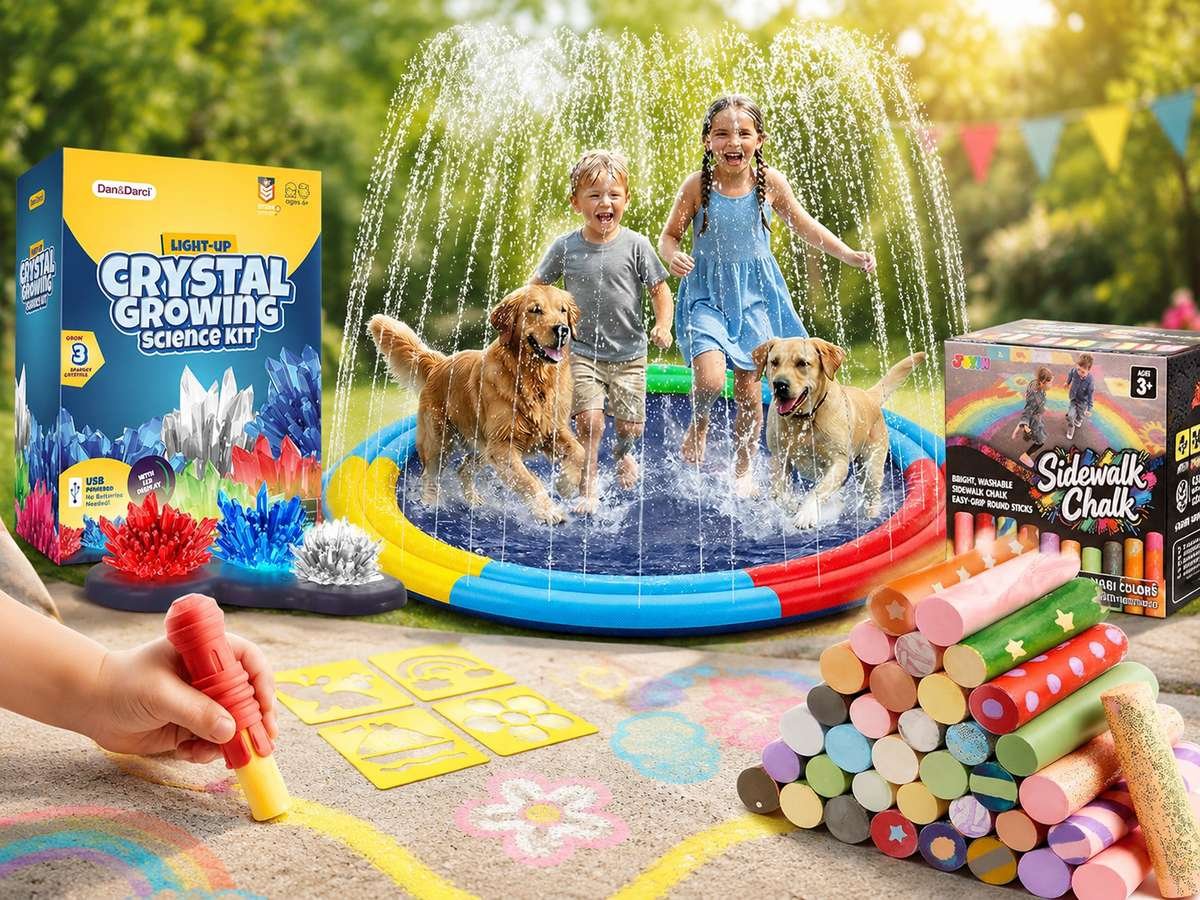
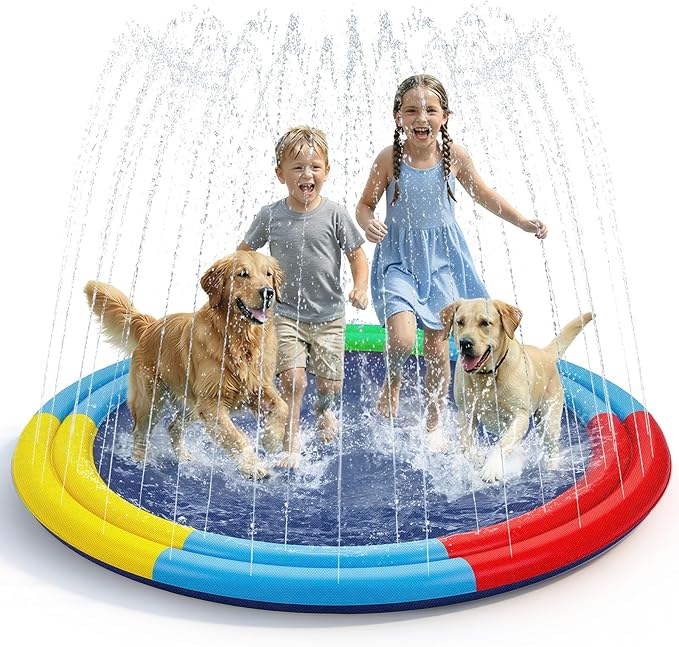
Why we love it: For hot summer days when going to the splash pad isn’t in the cards, a backyard splash mat is the single best swap I’ve found. You connect it to the garden hose, turn the water on, and that’s the complete setup. No filling, no draining, no inflating, no storing a giant inflatable pool in your garage for eight months. My twins run out there and I have genuinely not thought about them for forty-five minutes at a stretch. That’s a summer miracle in this house.
The flat design is what makes these mats so practical to actually own. They dry fast, roll up small, and don’t require a pump or special storage. The low barrier to getting started is the whole point: if setup takes more than sixty seconds you’re already negotiating with kids who have run out of patience. Kids ages two and up can run, stomp, and splash completely on their own without needing you in the yard to supervise every second. Pair it with some sidewalk chalk nearby and you have covered the entire outdoor morning without setting foot outside yourself.
- The win: Connects to any garden hose for instant water play with zero pool setup, filling, or draining
- The time-save: Kids run and splash independently for 30 to 60 minutes without needing you to direct the activity
-
The relief: Flat design dries fast and rolls up small so storage doesn’t become a whole project when summer ends
-
Real talk: These mats are designed for outdoor use, so on truly scorching days the surface itself can get warm in direct sun. Set it up in a shaded spot or run the water for a minute before kids get on to cool it down.
Water play handles the outdoor hot days beautifully. But what about when you have a kid who’s over the splash pad phase and wants something that actually challenges their brain? That’s where the science kit earns its spot in the summer rotation.
The Backyard Science Win: Experiments Kids Run Themselves
The Morning Flow Maker: My middle-schooler is at the age where he finds most “kids activities” deeply insulting, but put a science experiment kit in front of him and something clicks back on. Every supply is in the box. The instruction cards are written so kids can actually follow them without a parent standing there translating. He sets up at the kitchen table, works through the steps, and I check in about thirty minutes later to see what he made. That is a genuinely free thirty minutes for me, which in summer is pure gold.
After reading through reviews and talking to parents in our school pickup group, the kits that work best are the ones where every ingredient is included and the instructions are genuinely kid-friendly. When kids have to stop and ask for help every five minutes the activity falls apart, but when they can run the whole experiment themselves it sustains engagement in a way that other activities just don’t. Look for kits rated for your child’s age that specify “no additional supplies needed” because that detail is what makes the difference between an activity that actually happens and one that stays in the packaging.
Each experiment typically runs twenty to forty minutes, which means a two-experiment kit gives you a solid hour of independent kid engagement on a rainy afternoon. For the older kids in your house, this one pays for itself in quiet time alone.
- The payoff: Every supply is included so kids can start immediately without a trip to the store or mom gathering ingredients from around the house
- The flow-maker: Step-by-step cards are written for kids so they can run experiments independently without constant adult direction
-
The habit-builder: Multiple experiments in one kit means this activity fills an entire rainy day, not just one morning session
-
Fair warning: Science experiment kits have a wide quality range. Check that the kit is appropriate for your child’s specific age, since kits rated 8 and up use different complexity than kits rated for 5 and up. Reading the age range on the box is worth the extra thirty seconds.

Science kits are perfect for curious kids who need a real challenge. But what about the artists in your house who want to make something colorful and big and are definitely going to want to do it outside? That’s exactly what the next pick is built for.
The Mess-Free Outdoor Artist: Color Outside the Lines
The Sanity-Saver: Sidewalk chalk sounds obvious until you see what a genuinely good chalk set does to a summer afternoon. My daughter can spend an entire morning filling the driveway with elaborate drawings, stories, and what she describes as “a whole neighborhood.” She asks for nothing. She doesn’t need me to suggest what to draw. She doesn’t need supplies restocked. She just draws until she runs out of driveway, which takes longer than you’d expect. And when it rains, the whole thing washes away and she starts fresh the next dry day. Zero mom involvement required, and the cleanup happens automatically.
I swear by sets that come with stencils because the stencils give kids a starting point without limiting their imagination. When kids have a few shapes to trace as anchors they stay engaged significantly longer than when they’re staring at a blank driveway wondering what to draw. Jumbo chalk is the other non-negotiable: the bigger size is easier for small hands to grip and the bolder lines are more satisfying, which means the activity holds attention longer. This is one of those activities that works for ages three through ten in the same afternoon, which is rare and worth noting.
- The win: Washes away with rain or a hose so there is no yard cleanup, no permanent mess, and no guilt about letting kids cover every surface
- The time-save: Stencils give kids a starting point so they stay engaged longer without needing you to suggest ideas or redirect the activity
-
The relief: Works for ages 3 through 10, so siblings of different ages can all create in the same outdoor session
-
One thing to know: Sidewalk chalk works best on concrete or smooth asphalt. Rough pavement wears the chalk down fast and dulls the colors. Stick to the driveway or front path for the most satisfying results.

Chalk covers the beautiful outdoor mornings when everyone is in a creative mood. But on the days when it’s raining, too hot, or someone just has a ton of pent-up energy that needs somewhere to go, you need something that moves. That’s where the next pick comes in.
The Indoor Rain Day Hero: When Going Outside Is Not Happening
Why it makes rainy days easier: There is a specific kind of summer afternoon chaos that happens when you are stuck inside, it is raining, and the kids have been inside since 10 AM. It builds slowly. The requests get louder. The bickering starts. And you look at the clock and realize there are still three hours until dinner. What you need in that moment is something that burns real physical energy without requiring you to go anywhere or set up anything elaborate. A stomp rocket set does exactly that.
I swear by these for exactly that scenario. You stomp the launch pad with your foot, the foam rockets launch into the air, and kids spend the next thirty minutes chasing rockets up and down the hallway. No batteries, no charging, no app required. The foam rockets are soft enough to use indoors safely without putting dents in the walls or ceiling tiles. The fact that it requires actual physical effort from kids is what makes this work: they are genuinely tired at the end, not just visually stimulated. My twins turn it into a competition to see who can stomp hardest and launch highest, which adds another layer of engagement that extends the activity well past the first five minutes.
- The game-changer for rainy days: No batteries or charging needed, kids stomp to launch so the activity burns real physical energy rather than just occupying eyes
- The win: Soft foam rockets are safe for hallway or living room use without the drywall damage risk you get with harder toys
-
The time-save: Kids can run the competition independently without any adult involvement once they understand the basic stomp and chase loop
-
The honest trade-off: Stomp rockets can get loud, especially in an echo-y hallway. If you have a baby napping, this one is better for a time slot where sleep isn’t on the schedule.

Active indoor play covers the energy-burn need on rain days. But once the rockets have been launched approximately forty times and the kids are ready to sit down and make something, you need a creative activity that holds their hands busy without making a mess you’ll regret. This next pick is the one I reach for in exactly that moment.
The Creative Flow Maker: Builds and Creates Without the Mess
The After-School Win: Air dry clay is one of those supplies I should have discovered years earlier than I did. My daughter found a modeling clay set at a friend’s birthday party and was completely absorbed for the entire party, which should have been my first clue. The texture is satisfying in a way that Play-Doh isn’t quite, and the fact that the finished pieces actually harden means kids feel like they made something real. The self-drying formula is what makes this genuinely different: kids finish their creation, set it aside, and it hardens on its own overnight. No oven, no adult supervision of a heat step, no waiting around.
After looking through hundreds of reviews for sets across different age ranges, the picks that hold up best are the ones that come with molds and tools included. When kids have cutters, rollers, and shaped molds to work with they can generate their own ideas and work completely independently from start to finish. The bright colors are a big part of the engagement: a set with six or more colors gives kids enough variety to mix, match, and invent without running out of possibilities mid-session. Expect a solid thirty to forty-five minutes of focused, quiet creative play, which in summer terms is a full and complete win.
- The relief: Air dry formula means kids can finish a creation and leave it to harden without needing the oven, mom supervision, or a heat step
- The payoff: Included molds and tools give kids the structure to work completely independently from start to finished piece
-
The flow-maker: Bright color variety keeps kids mixing and experimenting for 30 to 45 minutes of genuinely focused play
-
Skip this if: Your child is still mouthing everything, since modeling clay is not safe to ingest. Hold off until they’re reliably past that stage before adding clay to the rotation.

Creative clay covers the sit-down creative sessions perfectly. But the last piece of a real summer rotation is something that fills the quiet afternoon stretch, works independently for older kids, and builds something worth keeping at the end. That’s what the final pick in this lineup is built for.
The Summer Reading Win: A Journal That Kids Reach For Themselves
Why This Earns Its Spot: Here’s the thing about summer journals that most kids’ activity lists miss: the right journal is not a homework assignment. It’s a creative outlet. When the prompts are interesting enough and the pages feel like an invitation rather than a task, kids actually reach for it on their own. My middle-schooler’s summer journal from last year is still sitting on his desk because he genuinely liked filling it out, and that is not something I ever expected to say about a writing activity in summer.
The prompted journals that work best ask open questions with space for drawing and writing, so kids who would rather draw than write can still engage fully and kids who want to fill three paragraphs have room to do that too. Thousands of parents in the reviews note that their kids started the journal on the first day and filled it faster than expected, which is the exact opposite of the forced reading log energy you’re trying to avoid. A good summer journal turns the afternoon quiet time into something kids do willingly instead of something you negotiate into existence. Grab it at the start of summer and introduce it as a special summer-only book, and it becomes part of the daily afternoon rhythm all on its own.
- The win: Prompted pages give kids a starting point so they can journal and draw independently without asking mom what to write
- The habit-builder: Combining drawing and writing prompts makes it accessible for reluctant writers and creative kids in the same household
-
The payoff: A single journal session fills 20 to 40 minutes of quiet solo time, making it a reliable afternoon reset that moms can count on daily
-
Fair warning: Journals work best for ages 5 and up who can read the prompts independently. For younger toddlers, pair with a drawing-only activity book or read the prompts aloud together as a short bonding moment instead.

The Mom Win: A Summer Rotation That Actually Works
Remember that 9 AM boredom spiral, the eleven “I’m bored” declarations before the coffee was even finished? Here is what it looks like with this rotation in place instead.
The splash mat goes out on the hot days and kids run outside for a full hour while you get something done at the kitchen table. The science kit covers the curious kid on rainy days with thirty to forty minutes of self-directed experiments. The sidewalk chalk handles the big beautiful mornings when they just need outdoor creative space. The stomp rockets burn energy on the stuck-inside days without turning into a screen session. The air dry clay fills the sit-down creative afternoons when they want to make something real. And the summer journal lands in the afternoon quiet time and actually gets opened because the prompts are interesting enough to want to answer.
None of these require elaborate prep. None of them need mom to run the activity from start to finish. Each one solves a specific kind of summer day, and together they cover the whole season. That’s not luck, that’s a system. And a system is what turns summer break from something you survive into something you actually enjoy.
If you’re looking for more ideas that work without screens, our post on screen free toddler activities is worth bookmarking now. And when the afternoon hunger hits in the middle of one of these activities, our toddler snack ideas list has you covered with options that are fast to put together.
You’ve got this, mama! Drop a comment below and tell me which of these is going into your summer rotation first. I love hearing what is actually working in other families right now.
Don’t forget to pin this article!