6 Screen-Free Kids Activities Kids Will Reach for on Their Own
The Afternoon Screen Battle in our house had a very specific shape. Three o’clock would hit, my middle-schooler would disappear to his room with his phone, and my twins would start arguing over who had the tablet last. I’d suggest something else. They’d say it was boring. I’d suggest something else. They’d go quiet. I’d suggest a third thing. Someone would cry. By the time we landed anywhere productive, 45 minutes had evaporated and I still had dinner to start.
What killed me wasn’t the screens themselves. It was the negotiation. Every single day, the same loop. I started to feel like I was losing a battle I hadn’t signed up to fight.
So last summer I made a decision to stop suggesting activities and start building a system. Not a rigid schedule or a screen-time chart with gold stars. Just six go-to picks that lived somewhere accessible, stayed ready, and my kids would actually choose without me standing there coaching them. Here’s how these 6 screen-free kids activities turned that daily 45-minute loop into actual peace.
This post contains affiliate links. As an Amazon Associate I earn from qualifying purchases, at no extra cost to you!
6 Screen-Free Activities That Build a Real System at Home
The Blank-Canvas Solver: When Open-Ended Building Does the Work
Why we love it: The hardest part of keeping kids off screens isn’t the device itself. It’s that blank moment right after the screen disappears. They don’t know what to do with themselves, and if nothing’s immediately obvious, the default goes straight back to the tablet. The LEGO Classic Creative Brick Box eliminates that blank moment entirely, because there’s no instruction booklet, no right answer, and no “finished.” Your kid sits down, grabs a handful of bricks, and starts building whatever is in their head.
My son built a spaceship. My daughter made a tiny pink house. My other twin built what he described as “a lunchbox for a dinosaur.” I couldn’t tell you how much time went by. And that’s exactly the point. Open-ended building creates its own momentum, and once kids are in it, they stay in it. The bricks come sorted and organized into a box that makes cleanup straightforward, and because the box is self-contained, it can live on a low shelf where kids grab it independently. No asking. No setup. Just sit down and build.
We’ve had ours for almost two years now and the box still comes out multiple times a week. I swear by this one for filling the “I don’t know what to do” moment faster than anything else in our house.
- The win: The open-ended format means kids create their own challenge, so they stay engaged longer than with any directed build.
- The time-save: Sorted storage means they can start immediately without digging through a bin or asking for help.
-
The relief: No instruction booklet means no “Mom, I’m stuck” interruptions pulling you away from whatever you’re trying to do.
-
Real talk: Tiny pieces will eventually escape the box. If you have a crawler or a toddler at home, keep this one as a table-only activity.

Now that the blank-moment problem is handled, the next piece of the screen-free puzzle is building something with a little daily rhythm. Something your kids check on. Something that creates its own pull without you suggesting it.
The Daily Habit Hero: The Activity They Come Back to Every Single Day
Why it makes afternoons easier: Here is what I discovered almost by accident: kids who have something to tend are kids who stay off screens. My twins started watering their terrarium every afternoon when they got home from school. I didn’t ask them to. I didn’t remind them. They just did it, because the terrarium was there and it was theirs and something was happening inside it.
The Grow n Glow Terrarium Kit became part of their daily rhythm in a way that no toy had before it. They water it in the afternoon and then check on it again before bed because it glows in the dark at night. That’s two built-in screen-free moments every single day, and neither one required me to orchestrate anything. After reading through hundreds of reviews and more than a few parenting forum threads, here’s what I kept seeing: kids treat their little garden like a pet. They name the plants. They measure the growth with a ruler they found somewhere. They show it to anyone who comes over. That level of ownership is genuinely powerful for kids who normally gravitate toward passive screen time.
The glow feature is not gimmicky. It’s the reason my kids actually check on it at bedtime instead of asking for one more episode of something.
- The habit-builder: Daily watering creates a natural screen-free ritual kids maintain themselves without prompting.
- The payoff: The glow-in-the-dark feature builds in a second daily check-in at bedtime that eases the evening screen pull.
-
The flow-maker: Watching something grow over days and weeks builds patience and pride in a way that instant-reward screens never do.
-
Fair warning: There’s a sprouting window at the start where nothing visible is happening yet. Hang in there. Once they see the first tiny green shoot, they are completely hooked.

Building and tending are wonderful. But some afternoons what your kids actually need is a creative outlet where they make something, display it, and feel genuinely proud of it. That’s where the next pick earns its spot.
The Always-Ready Station: When the Art Just Happens
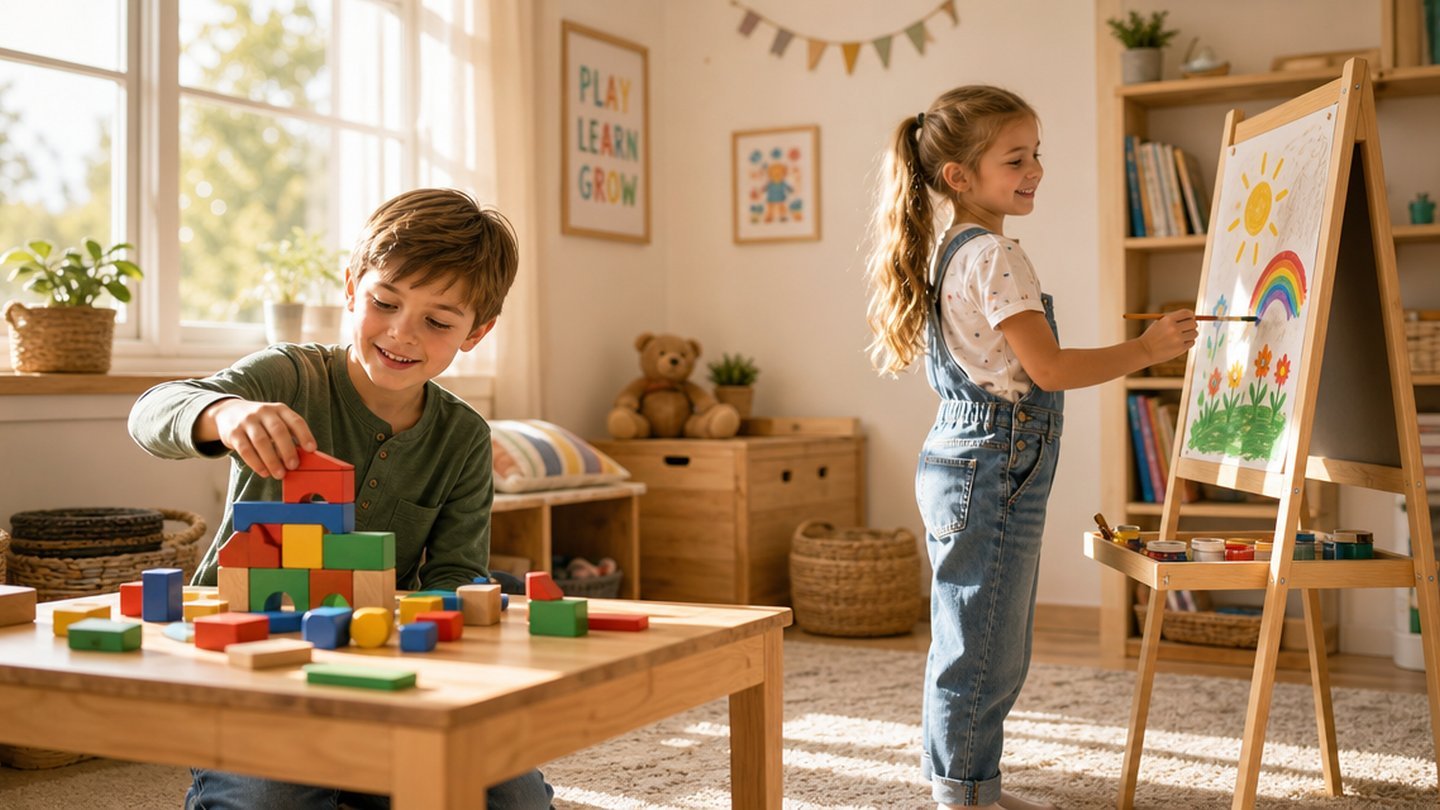
The Sanity-Saver: The reason most art projects don’t happen in our house isn’t because my kids don’t want to do them. It’s because setup takes too long. By the time I’ve found paper, tracked down markers that still have caps, and cleared enough table space, the moment is gone and someone’s back on a device. A kids’ tabletop art easel with a built-in paper roll solves the entire problem. The supplies are already there. The surface is always fresh. Your kid sits down and starts.
I set ours up in the corner of the dining room, and I cannot tell you how many times I’ve walked by and found a twin just quietly drawing. No suggestion from me. No prompting. They just gravitated to it because it was out and ready and the blank paper felt like an invitation. The paper roll is the real secret: it means there’s always a fresh surface without tearing out sketchbook pages or running out at the worst moment. You rip off a new section and go.
My twins have gone through that paper roll three times. I have a small army of their drawings tucked in a folder. I’m keeping every single one.
- The relief: No setup required means kids start creating immediately instead of losing the urge while you gather supplies.
- The game-changer for afternoon downtime: A dedicated art station gives creative time a physical home in your house so kids know exactly where to go.
-
The win: A paper roll provides an endless canvas so momentum never stalls mid-project.
-
One thing to know: Some easels come with a small tray that doesn’t hold much. Keep a separate supply caddy nearby so markers, colored pencils, and brushes are easy to grab without hunting.

Your kids are building, tending, and creating. The next gap in the screen-free afternoon is usually that 4 PM energy spike when everyone gets loud and restless and the house starts to feel a little unhinged. That’s the moment you need to get them outside, and fast.
The Two-Minute Energy Burner: Outside Before You Can Say Bored
The After-School Win: My kids have a window between 4 and 5 PM when the energy level in our house becomes genuinely chaotic. Stomping, chasing, loud voices, someone always ends up in tears. The Stomp Rocket has become my go-to for redirecting that window because the setup is literally 30 seconds and it gets everyone outside before they have time to argue about it.
You stomp the base, the foam rocket launches into the air, and suddenly three kids are sprinting across the yard to retrieve it and arguing about who gets to stomp next. The argument is actually good in this context. It’s outdoor, physical, device-free arguing. I will take that every single time. We’ve had ours for two full seasons now and it’s still going strong. No batteries. No app. No charging. You stomp, it flies, you chase it. That’s the entire product and that simplicity is exactly why it works so consistently.
The Stomp Rocket Deluxe comes with multiple rockets, which matters because one will eventually land on the roof. I say this from lived experience. Having a backup rocket means the game doesn’t end.
- The time-save: Thirty-second setup means you can redirect the 4 PM energy spike before it escalates into full indoor chaos.
- The payoff: Physical play burns enough energy that the hour after outdoor time is noticeably calmer for everyone in the house.
-
The game-changer for after-school time: The competitive launching element keeps multiple kids engaged together without any adult facilitation.
-
Skip this if: You have no outdoor space at all. This one really needs a yard or open area to deliver on its promise.

The energy is out and everyone has come back inside a little calmer and a little more tired. The final stretch of the afternoon needs something quieter. Something that signals the loud part of the day is winding down and that screen-free time can still be cozy.
The Quiet Focus Factor: Wind-Down That Does Not Involve a Screen
The Sync Factor: Here is something I genuinely did not expect: floor puzzles have become one of the most effective screen-free wind-downs in our house. Not because I suggested it and pushed it for weeks. Because once my twins did one together and finished it, they got competitive about doing the next one faster. And then a harder one. Now a new puzzle is real currency in our house. “If homework gets done without drama, we open a new puzzle tonight.” My kids negotiate for that reward.
Thousands of parents consistently give Ravensburger puzzles top marks specifically for quality, and I understand why after reading through the reviews. The pieces snap together more crisply than cheaper brands. The imagery is clear and inviting. They don’t fall apart when kids slide them around the floor mid-solve. The floor format works especially well for siblings because everyone can work on a different section simultaneously without fighting over one small table. My twins invented a “no claiming edge pieces” rule entirely on their own. I did not teach them that and I am very proud of them for it.
Floor puzzle time has naturally become our transition ritual from loud afternoon to calm evening. The puzzle goes down, the voices get quieter, and the house finds its breath again.
- The habit-builder: Completing a puzzle creates a satisfying sense of accomplishment that makes kids want to try the next one immediately.
- The flow-maker: The floor format lets multiple kids work at the same time, making it a low-conflict sibling activity on even the most chaotic days.
-
The relief: Quiet focused puzzle time naturally signals the shift from active afternoon to calm evening without a screen doing the work.
-
The honest trade-off: You do need floor space for this one. If your space is tight, a puzzle board or felt mat lets you slide the whole thing out of the way without losing a single piece.

The last piece of the screen-free day is the one that replaces the after-dinner scroll. That 30-minute window when everyone is full and a little tired and the default is to drift toward a device. This is where the final pick does its best work.
The Together-Time Game-Changer: When Everyone Puts Down Their Device
Why This Earns Its Spot: Getting a middle-schooler and elementary-age twins to play the same game without someone declaring it babyish is genuinely hard. Skillmatics Guess in 10 is one of the only games in our cabinet that all three of my kids reach for voluntarily. The premise is simple: you ask yes-or-no questions to identify an animal in 10 guesses or fewer. But it moves fast, it gets competitive, and it generates real conversation. My son loves stumping his little sister. She loves getting one right before he does. My other twin just loves shouting answers. That’s the whole formula and it works every single time.
After dinner, instead of everyone drifting to their separate screens, we built a 20-minute game window into our evening. It started as something I suggested and now my twins ask for it before I’ve even started clearing the dishes. That shift, from me orchestrating screen-free time to them choosing it without prompting, is the entire goal of this whole system. The card game is the piece that made the evening click.
The rounds are fast enough that nobody loses interest, and the rules are simple enough that the twins can lead a round themselves without me explaining anything. From one tired mom to another: this one is worth every dollar.
- The payoff: After-dinner game time replaces the post-meal scroll with real conversation and sibling connection that actually lasts.
- The win: Works across a wide age range so your middle-schooler and younger kids can genuinely play together without anyone checking out.
-
The game-changer for after-dinner time: Fast rounds hold everyone’s attention without turning into a long commitment nobody wanted.
-
Real talk: The categories focus on animals, which is kid-friendly and universally accessible. Once your kids have mastered it, grab a second deck in a different category to keep it fresh.
The Payoff: What Afternoons Look Like Now
Remember that 45-minute negotiation loop I was describing? The one that happened every single day and left everyone frustrated and me feeling guilty? Here is what our afternoons look like now.
The twins come home from school and one of them usually heads straight to the LEGO box or checks on the terrarium before I’ve even set down my bag (solve #1 and #2). The art easel gets visited at least a few times a week without any suggestion from me (solve #3). When the 4 PM energy spike hits, I send everyone outside with the Stomp Rocket and I get about 30 genuinely quiet minutes to myself (solve #4). Wind-down time involves a puzzle on the floor instead of a tablet (solve #5). After dinner, we play Guess in 10 and someone is always laughing before it’s over (solve #6).
I’m not telling you we never have screen time in this house. That would be a lie and we do not do lies here. But I’m telling you the ratio flipped. And it flipped because we gave them a system, not a list of rules. The screens didn’t disappear. They just stopped being the default.
If you’re in the thick of the screen battle right now, I see you, mama. It is genuinely exhausting to negotiate something that feels like it should just be easy. Start with one pick from this list. Just one. Put it somewhere accessible. Keep it out and ready. And watch what happens when the blank moment meets something interesting.
You’ve got this, mama! Drop a comment below and tell me what your kids gravitate toward when screens aren’t an option. I am always expanding our rotation and I love hearing what works for other families.
And if you’ve got a little one still in toddler territory, check out our posts on screen-free toddler activities and toddler snack ideas for more ideas that fit that season of life too.
Don’t forget to pin this article!