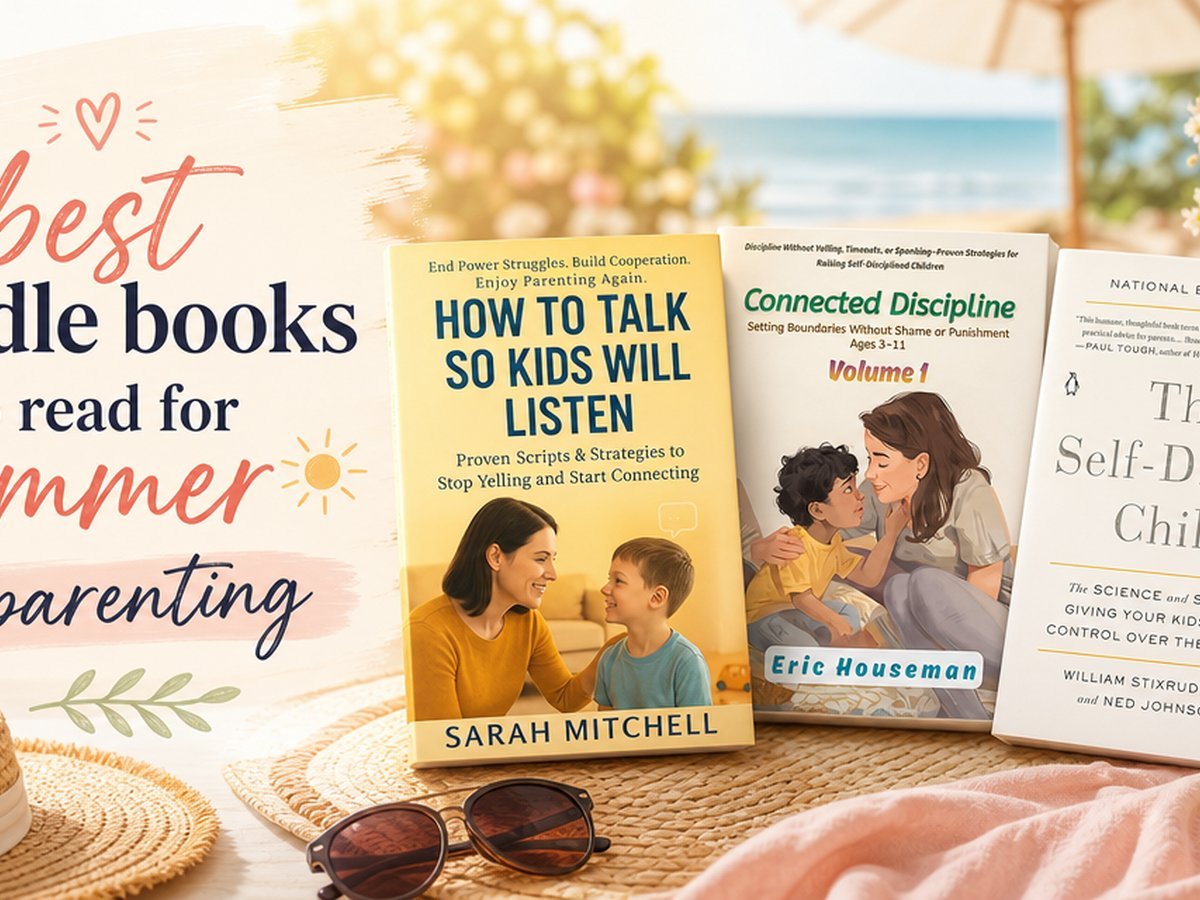
Parenting Kindle Books That Change the Whole Summer
Last July I snapped at my son over a wet towel on the bathroom floor and spent the rest of the day feeling like the worst mom alive. It wasn’t even about the towel. It never is, right? It was the accumulation of a hundred small moments where I had no idea what I was doing or why I kept reacting the same way. I had the best intentions and zero actual tools.
That night I downloaded a parenting book on my Kindle instead of doomscrolling. By the end of that summer I had read three of them, and I will be honest with you, something genuinely shifted. Not a magical cure-all. Not suddenly perfect. But I stopped feeling like I was parenting on autopilot and hoping for the best.
Here’s how these six books together give you a complete summer parenting toolkit, one layer at a time.
This post contains affiliate links. As an Amazon Associate I earn from qualifying purchases, at no extra cost to you!
6 Parenting Kindle Books for a Summer Reset
The Communication Game-Changer: When Talking Actually Works
Why we love it: How many times have you said the right words and gotten the exact opposite response you were hoping for? The reason is almost always delivery, not intention. “How to Talk So Kids Will Listen and Listen So Kids Will Talk” by Adele Faber and Elaine Mazlish is the book that finally explains why kids tune out the lecturing, correcting, questioning voice and what to replace it with instead.
This is Tier 1 for me, honestly. I’ve had a copy for years. The approach centers on validating feelings before problem-solving, which sounds obvious until you realize how rarely any of us actually do it in a heated moment. When my middle-schooler comes home in a terrible mood, I used to immediately try to fix it. This book taught me that the fixing is the problem. The specific language it offers for defusing conflict, acknowledging emotions, and getting genuine cooperation is the kind of thing you start using the same week.
- The time-save: Fewer circular arguments that eat up everyone’s energy and go nowhere
- The relief: Kids who actually feel heard are way more likely to cooperate than kids who feel lectured at
- The win: Works at every age from the toddler who won’t put on shoes to the teenager who won’t explain what is wrong
Real talk: This book is straightforward enough that if you already have a strong instinct for emotional attunement you may feel like it confirms what you already know. Still worth it for the specific scripts.

Once you know what to say in the moment, the next piece is figuring out what to do when the words don’t work and the whole situation has already blown up.
The Discipline Reframe Hero: No More Power Struggles
The Sanity-Saver: If “How to Talk” teaches you the communication layer, “No Drama Discipline” by Daniel Siegel and Tina Payne Bryson teaches you the discipline layer. And the reframe is massive. Discipline is not about punishment. It’s about teaching. That sounds like a bumper sticker until you read the research behind why punishment escalates instead of resolves.
After going down a rabbit hole of reviews and the Bryson-Siegel research base, here’s what I kept seeing over and over: the connect-then-redirect strategy actually works because it works with how the brain operates under stress, not against it. When your kid is dysregulated, the reasoning part of their brain is genuinely offline. Trying to discipline a kid in that moment is like trying to teach algebra to someone who is having a panic attack.
The book gives you real-world scripts for what to say when things fall apart, including the moments when you are also dysregulated and running on empty. That specificity is what separates this from vague advice to “stay calm.”
- The payoff: Power struggles start to dissolve when you stop fighting the brain science and start working with it
- The flow-maker: The connect-then-redirect framework is short enough to remember and use in an actual hard moment
- The game-changer for morning meltdowns: Understanding why your kid goes from zero to full meltdown in thirty seconds makes you less reactive and more effective
Fair warning: This one asks you to look at your own regulation first before addressing your kid’s, which can feel hard when you are already maxed out. Worth it. Plan to sit with it.

Now that you have communication and discipline covered, summer is the perfect season to try something that sounds counterintuitive but genuinely changes everything: giving your kids more control.
The Autonomy Factor: Raising Kids Who Actually Listen
Why it makes mornings easier: Here is a thing that broke my brain when I first read it: kids who have more control over their own lives are actually less anxious and more cooperative than kids who are managed and directed constantly. “The Self-Driven Child” by William Stixrud and Ned Johnson makes this case with brain science and it is deeply convincing.
Thousands of mamas are leaving five-star reviews on this one, and I get why. The “sense of control” piece explains so many things I had been struggling to understand, including why my son digs his heels in on the exact things I push hardest on. When you start offering genuine choices instead of controlled ones (“do you want to do homework now or after dinner?” versus “do your homework”), the shift in attitude can feel almost immediate.
Summer is the best time to experiment with this because the schedule is looser. You have room to let your kids practice making choices and experiencing natural consequences without the pressure of a school-year timeline.
- The habit-builder: Kids who practice making choices during summer arrive at the school year with more self-management already built in
- The relief: Fewer battles over homework, chores, and screens when the kids have had genuine input into how those things work
- The payoff: The internal motivation that results from self-direction is the thing all the external rewards and punishments can never buy
One thing to know: This book leans toward older kids and tweens. If your crew is mostly toddlers and early elementary, the communication and discipline books above will feel more immediately practical.

With the communication, discipline, and autonomy pieces in place, the last real blocker for most mamas is the reaction itself. What happens in the thirty seconds between trigger and response.
The Mindful Parenting Saver: Breaking the Reaction Cycle
The After-School Win: The hardest parenting moments are not the ones you can prepare for. They are the random Tuesday at 5 PM when everything goes sideways at once, your patience has been fully spent, and you still have three hours until bedtime. “Raising Good Humans” by Hunter Clarke-Fields is the book that addresses that gap specifically.
I spent an afternoon reading through the reviews so you don’t have to. What keeps coming up is this: Hunter Clarke-Fields doesn’t ask you to be calm all the time. She teaches you why you react the way you do (which is usually rooted in how you were parented, not a character flaw) and gives you practical tools to shorten the window between trigger and recovery. A ninety-second reset is achievable. Permanent serenity is not, and she’s honest about that.
The mindfulness tools here are not the sit-and-meditate variety. They are the micro-practices you can do in a kitchen while kids are yelling, which makes them actually useful.
- The time-save: Recovery time between losing it and getting back on track gets genuinely shorter with practice
- The relief: Understanding the “why” behind your own reactions removes the shame spiral that usually follows a hard moment
- The win: Kids raised by a parent who can model self-regulation learn it much faster than kids who are just told to calm down
Skip this if: You are looking for more of a behavior management guide. This one is about YOUR reactions first, your kids’ behavior second. That is intentional, and it is the right order.

Once you are working on your own responses, the next piece is understanding how each of your kids is uniquely wired for connection, because what fills one child up completely empties another.
The Connection Game-Changer: Understanding How Your Kid Is Wired
The Sunday Reset Hero: My twins are wildly different from each other, which probably sounds obvious but the actual implication took me too long to land on: what makes my daughter feel loved and reconnected after a rough day is completely different from what my son needs. “The 5 Love Languages of Children” by Gary Chapman and Ross Campbell explains this in a way that finally made sense of why I kept missing the mark with one of them even when I was trying hard.
This is Tier 1 for me. We’ve talked about love languages at our house since my older two were little, and coming back to it through the lens of the specific kids I have right now, in 2026, at their specific ages, was genuinely useful. Chapman and Campbell walk through each love language with age-specific examples so you are not left translating abstract concepts into real behavior.
Summer is actually the ideal time to pay attention to this. You have more unstructured hours together, which means more natural opportunities to observe what lights each kid up and what leaves them flat.
- The game-changer for reconnection: Knowing your kid’s love language means a five-minute targeted reconnection actually works instead of requiring thirty minutes of effort
- The habit-builder: Teaching kids their own love language gives them words for what they need, which reduces the guessing-game dynamic that drains everyone
- The flow-maker: When you stop trying to connect in the same way with every kid and start connecting in their way, cooperation follows much more naturally
The honest trade-off: The book stays fairly surface-level on the “how to identify your child’s love language” piece. Give yourself a week of observation rather than trying to quiz your kid directly.

You have the communication tools, the discipline reframe, the autonomy framework, the mindfulness practices, and the love language lens. The last piece is the one most mamas skip: understanding where your own patterns came from and interrupting them.
The Pattern Breaker Payoff: Parenting Beyond Your Own Childhood
Why This Earns Its Spot: Every mama I know has had at least one moment where she heard her own mother’s voice come out of her mouth and felt something complicated about it. “The Book You Wish Your Parents Had Read” by Philippa Perry is the parenting book that addresses that layer directly, and it does it without making you feel like you are in therapy against your will.
After reading hundreds of reviews and following the conversation around this book in parenting communities, here’s what consistently comes up: it is less about technique and more about awareness. Perry, a psychotherapist, makes the case that most of the ways we parent that we don’t love trace back to how we were parented, not because we are broken but because we absorbed the model we grew up with. Seeing that clearly is the beginning of changing it.
The writing is warm and conversational, more like a knowledgeable friend talking to you than a clinical framework being handed down. It is one of those books that is hard to put down because every few pages you find something that lands quietly and specifically.
- The relief: Understanding where a pattern came from makes it much easier to interrupt than just trying to “do better” through willpower
- The payoff: Breaking a generational pattern is genuinely one of the most meaningful things a mama can do, even when it’s hard
- The time-save: Getting clearer on your own history now means fewer years of wondering why you keep reacting the same way
Real talk: This one will bring things up. It’s not heavy-handed or clinical, but it asks you to look honestly at your own childhood. Good summer read for a mom who has some quiet time, not necessarily one who is running on empty in crisis mode.

The Summer Parenting Reset You Deserve
Remember that Tuesday night when I snapped over a wet towel and spent the rest of the day spiraling? That moment is what happens when mamas have the love and the intention but none of the tools. These six books give you the whole toolkit.
You have the words that land with your kids instead of bouncing off them. You have a discipline approach that builds connection instead of resentment. You have an autonomy framework that turns summer into a season where kids practice self-direction instead of fighting every boundary. You have mindfulness tools that actually work in a real-life kitchen at 5 PM. You have the love language lens that makes five minutes of connection with each kid count. And you have the awareness to see where your own patterns come from so you can choose differently.
That is not a reading list. That is a system. And by September you’ll look back and realize this summer actually shifted something real.
For more inspiration on building routines your whole family loves, check out my posts on activities that fit into a mom’s day and screen-free kids activities for ideas on how to put all of this into practice with your actual crew.
You’ve got this, mama! Drop a comment below and tell me which one you’re adding to your reading list first. I read every single one.
Don’t forget to pin this article!