Chores for Teens: 6 Tools That End the Nag War
The Chore War Is Real, and It’s Exhausting
Let me tell you about The 9 PM Surrender. It’s the moment every night when I’ve already asked my middle-schooler four times to take out the trash, load his dishes, and wipe down the counter. He swears he was “just about to do it.” I’m standing there in my pajamas, tired in my bones, and I have two choices: pick another fight or just do it myself and resent everyone in a five-mile radius.
I chose the latter way too many times. And every single night it felt like a failure, not because the trash didn’t get taken out, but because I was doing it at 9 PM instead of him doing it at 7 PM, and we were both annoyed, and nothing actually changed.
The problem wasn’t that my son was a bad kid. It’s that our chore system was basically me being a walking reminder app that no one had installed properly. There was no visual cue, no structure, no moment of “I did it” that meant anything. Just me, asking again, and him ignoring again.
Here’s how these 6 tools turn that nightly standoff into a system that actually runs on its own.
This post contains affiliate links. As an Amazon Associate I earn from qualifying purchases, at no extra cost to you!
The Visual Accountability Hero: When Teens Need to See It to Do It
Let’s be real for a minute. Teens are not forgetting on purpose. Their brains are genuinely wired differently at this stage, and verbal reminders bounce right off. What breaks through? Visual cues they can’t unsee.
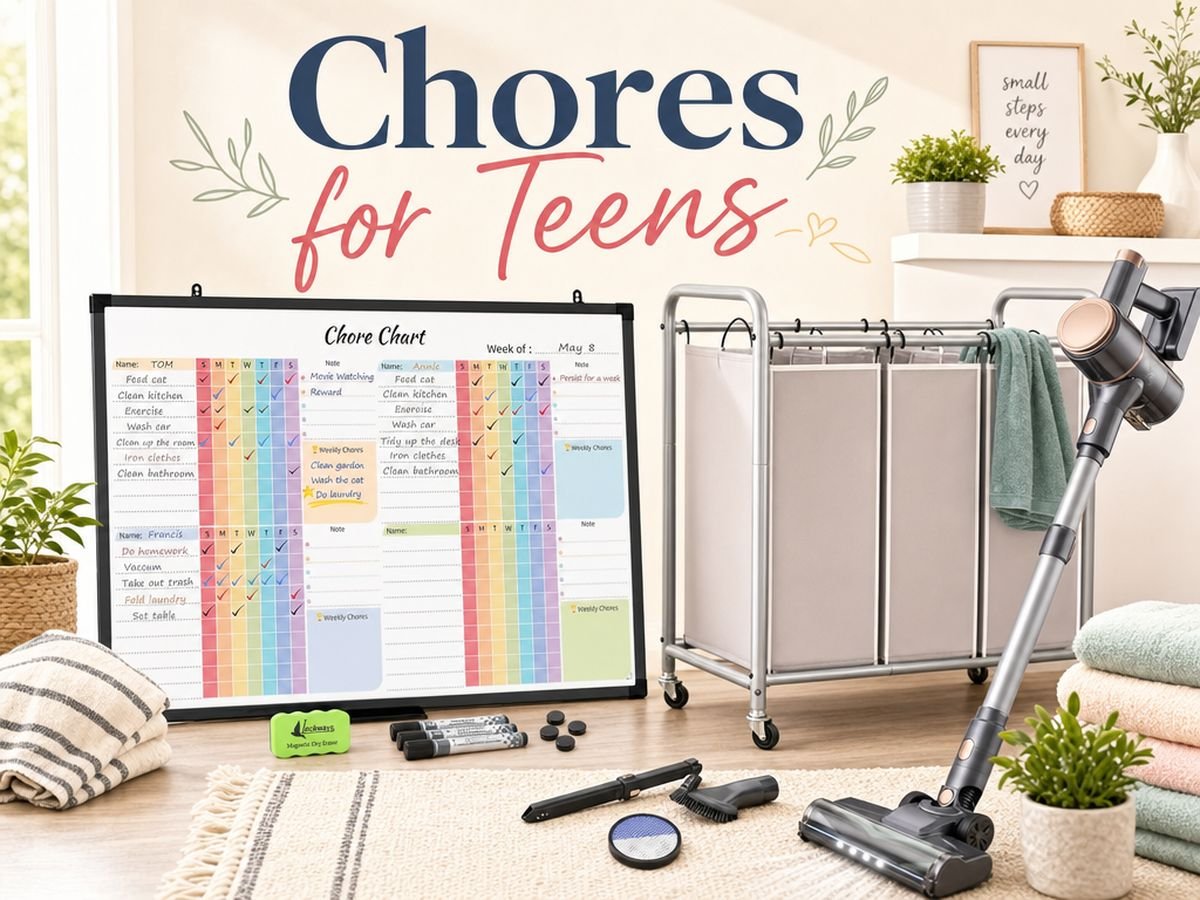
A large magnetic whiteboard chore chart on the wall of your kitchen or mudroom changes the entire dynamic. Expectations aren’t coming from Mom’s mouth anymore. They’re on the wall. Your teen can see exactly what’s expected, what’s done, and what’s not. No ambiguity, no “you never told me,” no negotiating.
I set ours up on a Sunday and told my son he was responsible for moving his task cards to the “done” column each day. The first week he forgot twice. By week two, he was checking it before I even thought about it. That’s the shift you’re looking for. Not perfect compliance overnight, but a new habit forming without my voice attached to it.
The magnetic surface means you can customize it every week. Add a new responsibility for the semester, swap out a task, post a note. After going down a rabbit hole of reviews, I kept seeing mamas say the same thing: once it’s on the wall, the argument disappears.
Why we love it: The nagging loop breaks because the wall is the reminder, not you.
The time-save: You stop repeating yourself every single evening.
The habit-builder: Teens who use visual systems carry that skill into school and eventually adulting.
Real talk: This only works if you set it up together with your teen, not for them. Spend 20 minutes deciding what goes on it as a team. If they build it, they own it.

With accountability visible on the wall, the next piece of the puzzle is the chore that causes the most friction in most households. Laundry.
The Laundry Independence Game-Changer: No More Sorting Their Clothes for Them
Laundry was the one chore I kept doing myself “because it’s just easier.” And it was. In the short term. But I was heading into my son’s teen years doing his laundry, and honestly? That was not the plan I had for either of us.
The sorting problem is what trips teens up first. They dump everything in one pile and then genuinely don’t know how to proceed. A three-bin laundry sorter on wheels solves this at the point of dirty clothes, not at the machine. When every item goes in the right bin as it comes off, there’s nothing to sort on laundry day. Your teen grabs the lights bin and starts a load. Done.
The wheels are the underrated feature here. My son wheels the whole sorter down the hall to our laundry closet, loads the machine, and wheels it back. He’s not lugging a 30-pound bag or forgetting a bin. The friction is gone, and when the friction is gone, the chore gets done.
Thousands of mamas are leaving five-star reviews on rolling laundry sorters, and I get why. It’s one of those things that feels like a small investment but changes the daily flow in a big way.
The payoff: Teens learn a real-life skill before they’re in a college dorm losing all their favorite shirts to a hot wash.
The relief: You stop being the laundry sorter for a teenager who is fully capable of doing it themselves.
The flow-maker: A sorted system means a 10-minute laundry start, not a 40-minute untangle session.
Fair warning: The first few loads won’t be perfect. Let that go. A slightly wrinkled shirt is way better than raising a 22-year-old who calls you for help with laundry.

Laundry handled. But the other big one, the bedroom floor that hasn’t seen carpet in three weeks, is still waiting. Let’s talk about vacuuming.
The Room-Cleaning Flow Maker: Why the Right Vacuum Actually Gets Used
Every parent who has asked a teen to vacuum their room has heard some version of “the vacuum is too heavy” or “the cord doesn’t reach” or my personal favorite, “I couldn’t find it.” These are not lies. These are friction points, and friction points are where chores go to die.
A lightweight cordless stick vacuum is the tool that makes this argument impossible. No cord to untangle, no dragging a heavy canister across the house, no hunting for an outlet. It lives in your teen’s closet, it charges on the wall, and it takes about 90 seconds to do a bedroom with it.
I’ll be honest, I did the research on this one before buying, and the reviews were consistent: teens who previously “hated vacuuming” started doing it without being asked because it’s actually easy. The quick-charge battery means it’s always ready. The compact size means your teen has no excuse for where to store it. It’s their tool for their space, and that ownership matters.
When something belongs to a teen, they take care of it differently. Give them this vacuum and make it theirs.
The win: A quick-charge cordless means it’s always ready, never “needs charging.”
The game-changer for their room: Teens can do the whole floor in under three minutes, which is within the attention span budget.
The relief: The “I couldn’t do it” excuse evaporates completely.
One thing to know: These aren’t whole-house vacuums. They’re perfect for bedroom-size spaces, not a full living room deep clean. Match the tool to the task and everyone’s happy.

So your teen can vacuum their room. But what about the bathroom counter, the kitchen sink, the quick wipe-downs? That’s where a cleaning caddy becomes your secret weapon.
The Sanity-Saver: Because “I Couldn’t Find the Cleaner” Is Not a Valid Excuse
We’ve all lived this moment. Your teen was supposed to clean the bathroom. You go check. It looks the same. You ask why. “I couldn’t find the spray.” You want to scream. I understand.
A portable cleaning caddy with a handle ends this excuse permanently. You load it once with their supplies: a multi-surface spray, a sponge, a few microfiber cloths, a scrubber. That caddy goes in their bathroom or in their section of the cleaning closet. It’s their kit. Their name goes on it, metaphorically at least.
When everything is in one place, a teen can clean the bathroom in about seven minutes. There’s no hunting, no “I thought we were out of cleaner,” no standing in the middle of the hallway looking confused. They grab the caddy, they do the task, they put it back. That’s a real system.
My sister-in-law set this up for her two teenagers last year and the thing that surprised her most was that they started refilling their own supplies when they ran out. Accountability creates ownership. Ownership creates maintenance.
The routine payoff: Zero “I couldn’t find it” moments. Ever again.
The time-save: A teen with a caddy can do a bathroom in seven minutes flat. No exaggeration.
The after-school win: Chores that used to take 30 minutes (because of supply-hunting) now take 10.
Skip this if: You want to share one cleaning kit for the whole house. Shared means no one owns it. Give each teen their own.

You’ve got the visual system, the laundry habit, the room cleaned, and the bathroom handled. But teens still drag out chore time like it’s a prison sentence. Here’s how to fix that.
The Time-Saver: Making Chores Feel Like a Sprint, Not a Sentence
Here’s the real reason teens procrastinate on chores. It’s not that they’re lazy. It’s that chores feel open-ended. “Clean your room” with no endpoint is basically “this could take forever and I hate it.” That’s not motivating for anyone.
A cube timer with preset intervals flips the whole experience. Your teen flips it to 20 minutes, the clock starts, and suddenly it’s a race. A manageable, finite, actually-possible race. The kitchen can get wiped down in 10 minutes. A bedroom can get picked up in 15. When time is visible and limited, teens move differently.
After spending an afternoon reading through the reviews on timers like these, the pattern was clear: parents report that chore resistance drops significantly when there’s a clear endpoint. Kids who were fighting chores for 45 minutes were doing them in 15 once a timer was introduced. That’s not a coincidence. That’s psychology.
The flip-cube design is key. There’s no screen to navigate, no app to open, no settings to argue about. Flip it, chores happen.
The win: Chores with a timer get done 2 to 3 times faster than chores without one.
The payoff: Teens feel accomplished when the timer hits zero. That tiny rush of “I did it” is real motivation.
The habit-builder: Short focused bursts are a skill that transfers directly to homework and study sessions.
The honest trade-off: Some teens will try to game the timer by working slowly just inside the time limit. Let them. Done at 80% is still done, and the habit is forming.

Almost there, mama. One more piece makes the whole system stick, and it’s the one that keeps teens wanting to show up for it.
The Accountability Win: Why Physical Rewards Still Work for Teenagers
I know. You’re thinking “my teen is too old for a sticker chart.” And fair enough, they probably are. But here’s what I’ve learned after years of trying to get my middle-schooler to care about chore completion: visible, tangible rewards still work, even for teenagers.
A chore token system or reward jar ties effort directly to something they actually want. Tokens for completed chores. Tokens that equal dollars, screen time, or privileges. Teens can see the jar fill up. They can see their work paying off in real time. That visibility is the key.
A friend from our school pickup group built this system for her 13- and 15-year-olds, and it was the first chore system that lasted more than two weeks in her house. The older teen started doing extra chores to earn more tokens. The younger one started racing to finish first. A reward system doesn’t undermine responsibility. It teaches teens that effort has value.
Start simple: one token per completed chore, five tokens equals one weekend privilege. Adjust as you go. The system grows with your family.
The win: Teens have a concrete reason to complete their chores beyond “because I said so.”
The relief: Fewer arguments about allowance because the token system makes earning transparent.
The payoff: Teens learn the work-reward connection that carries into every job they’ll ever have.
Real talk: This requires you to follow through consistently. If tokens don’t turn into real rewards, the system loses trust fast. Stay the course for at least 30 days.
![[Upgrade]Herda Magnetic Reward Jars for Kids with 54Pcs Smiley Tokens & 420 Holographic Star Stickers for Kids,Behavior Chart for Classroom,Reward Chart for Kids,Potty Training Chore Reward System](https://m.media-amazon.com/images/I/71rH0TYqhzL._AC_SX679_.jpg)
You’ve Already Won the Hard Part
Remember the 9 PM Surrender? Standing there in your pajamas, doing the chores yourself again while quietly seething? That version of your evening is done.
Here’s what you’ve built instead. A whiteboard on the wall means your teen knows exactly what’s expected, without you saying a word. A rolling laundry sorter means laundry day doesn’t start with a sorting argument. A cordless vacuum in their room means the bedroom floor actually gets cleaned. A cleaning caddy means no one can claim they couldn’t find the supplies. A cube timer means chores are a 15-minute sprint, not a four-hour battle of wills. And a reward system means your teen is showing up for it because there’s something in it for them.
That’s six pieces of one working system. None of them are magic on their own. Together, they change the whole rhythm of your evenings.
You’ll still have off nights. There will still be eye rolls and the occasional “I forgot.” But the nag war? The daily grind of repeating yourself until you give up and do it yourself? That’s the thing you’re leaving behind.
You’ve got this, mama! I’d love to hear what chore system is working in your house or what you’ve tried that absolutely didn’t work (solidarity, I’ve been there). Drop it in the comments!
And if you’re looking for ways to build responsibility habits younger, check out our post on chores for toddler for the smallest helpers, and if you need ideas for getting the whole afternoon under control, screen-free toddler activities is a great place to start.
Don’t forget to pin this article!