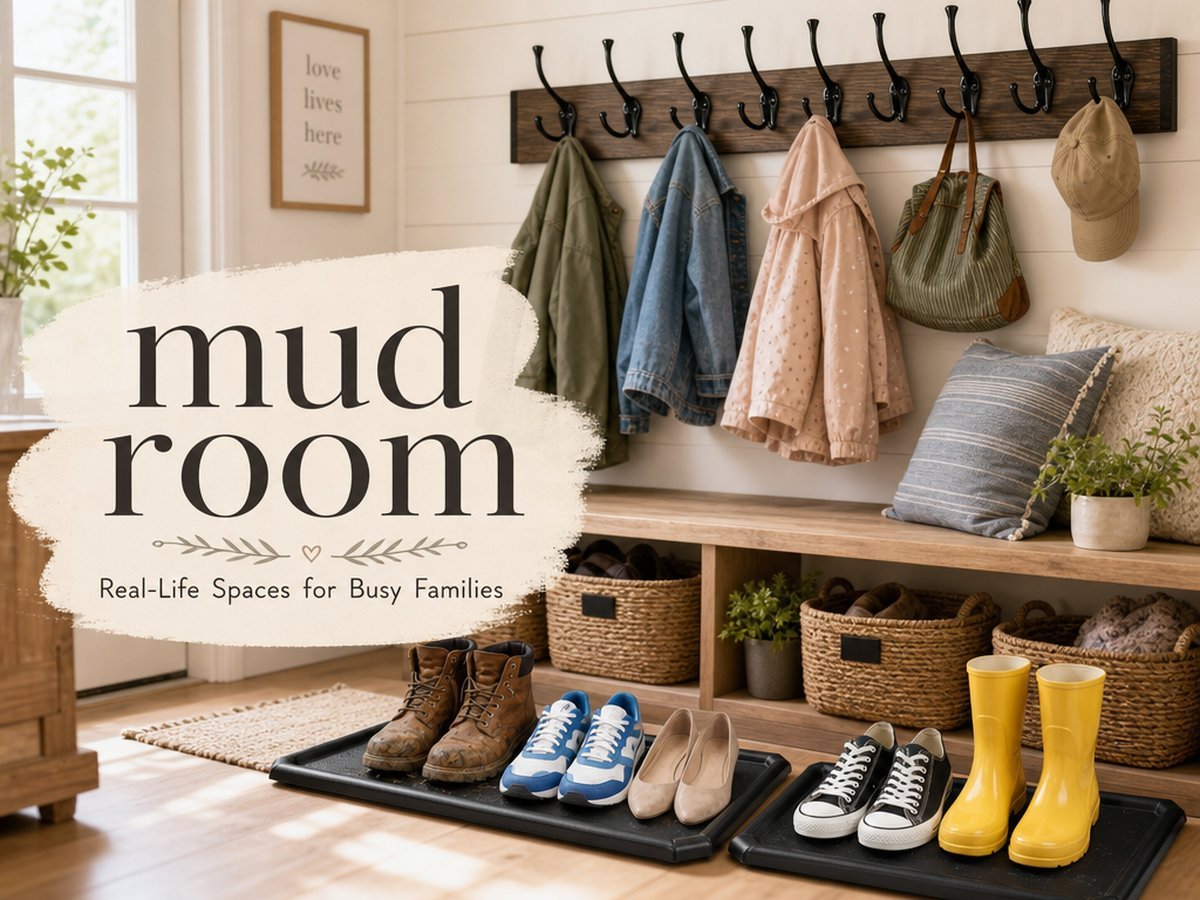
The Mud Room System That Ends the After-School Explosion
Three kids through the door at 3:15 and by 3:17 there are six shoes in the entry, three backpacks on the floor, two coats on the banister, and someone is already asking what is for snack. My middle-schooler drops his bag wherever his forward momentum stops. The twins race each other to kick their shoes off first, which means both pairs land in completely unpredictable locations. And somehow none of the three of them can find their shoes the next morning even though they were absolutely, definitely, right there.
The entry is the first room of the house and the most reliably chaotic one. Without a system, everything that comes in stays wherever it lands. And without specific spots for specific things, you cannot enforce a system because there is nowhere to direct people to. You cannot tell someone to hang up their coat when there is no hook to hang it on. You cannot tell someone to put their shoes away when there is no dedicated spot for shoes.
This is the thing that changed our entry: not rules, not reminders, not another conversation about picking things up. It was six products that gave every item a specific landing zone. Once the hook, the bench, the tray, the organizer, the baskets, and the rug were in place, the system ran itself. Here is exactly what we put in and why each piece matters.
This post contains affiliate links. As an Amazon Associate I earn from qualifying purchases, at no extra cost to you!
Six Products That Turn Your Entry Into a Drop Zone That Actually Works
Think of this as designing the entry around what your family actually does when they walk in the door, not around what you wish they would do. They are going to drop things. They are going to kick off their shoes without untying them. They are going to leave their coat on the nearest elevated surface. These products intercept every one of those habits and redirect them to a spot that keeps the entry functional without requiring everyone to become a different person.
The Drop Zone Anchor: A Hook for Every Person Who Walks Through That Door
Why this earns its spot: Every mudroom system starts with hooks, and the rule is simple: one hook per person, minimum. Not one hook for the whole family to share, not a hook that gets loaded up with four coats until it pulls off the wall. One hook per person, mounted at their height, with their name or their designated spot clearly associated. A wall-mounted coat hook rail with 5 or 6 hooks gives you that from the moment it goes up.
The rail style is the right call over individual hooks drilled at random intervals. A rail keeps everything at a consistent height and looks intentional even when every hook is loaded. It also makes it obvious when someone has skipped the hook and left their coat on the floor, because there is a visibly empty hook right there. That visibility matters more than it sounds. My twins started using the hooks consistently once they could see that there was a specific hook with their name on it. Before that, the instruction “hang up your coat” was abstract. After, it was “put it on your hook.”
What to look for: a rail long enough to give at least 6 to 8 inches between hooks so coats are not packed in. Double hooks that hold both a coat and a backpack are worth the slight extra cost if your entry doubles as backpack storage.
- The win: One hook per person means every coat has a real home so the banister and floor stop being the default drop spots
- The habit-builder: Named or assigned hooks make the instruction concrete for kids instead of abstract, which is what actually gets the behavior to stick
-
The space-save: Wall-mounted keeps the floor completely clear unlike a freestanding coat rack that tips, migrates, and takes up real floor space
-
One thing to know: Mount the hooks at each person’s actual reach height if you can. A hook that a 7-year-old cannot comfortably reach without stretching will not get used by that 7-year-old, regardless of what you say about it.

Coats handled. The next floor-space offender is always shoes, and the solution needs to work for real family foot traffic, not just a curated display of three pairs.
The Shoe Solution: Off the Floor, Out of the Way, Ready When You Need Them
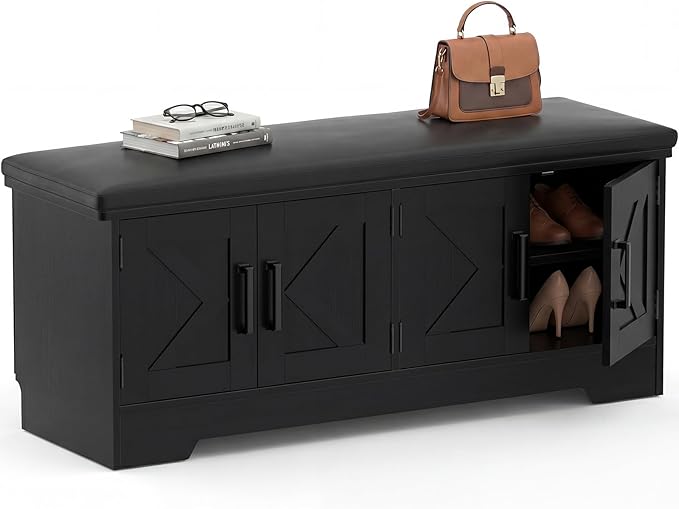
The organization payoff: Shoes are the most consistent source of entry chaos in most family homes because they come off the moment someone walks in and they go back on right before someone leaves. Which means they sit in the entry for all the hours in between, taking up floor space and migrating into everyone’s path. An entryway bench with shoe storage cubbies solves both problems at once: a seat for putting shoes on and a dedicated cubby for storing them when they come off.
The cubby structure is the key feature here. Open cubbies, one per family member, create the same kind of visible-home assignment that named hooks do for coats. The twins each have their cubby. The middle-schooler has his. My husband and I have ours. When a shoe is on the floor, you can point to the empty cubby and say “that shoe goes there,” which is a completely different instruction than “put your shoes away” with no designated destination. The bench seat also means there is a real place to sit while putting on shoes, which speeds up the leaving routine noticeably. We stopped standing around waiting for kids to finish the one-foot-hop-and-topple that happens when you try to put on a sneaker standing up.
- The win: A cubby per family member makes shoe storage visible and assigned instead of “somewhere by the door”
- The time-save: A real bench seat speeds up the morning leaving routine because everyone can sit and put on shoes at the same time
-
The dual function: One piece handles seating and shoe storage, which is two mudroom needs in the footprint of one piece of furniture
-
Real talk: Cubbies work best for shoes that are regularly worn. The occasional-use dress shoes and rain boots need a different spot the back of the closet or the boot tray. Do not try to fit everything into the bench cubbies.
Coats on hooks, shoes in cubbies. But there is still the issue of what comes in attached to the bottom of shoes on a rainy Tuesday or a muddy Saturday after soccer.
The Mud Stop: Containing Everything That Walks In Before It Gets Any Further
What this fixes in the entry: The entry floor is where all the outdoor mess makes its first contact with the inside of the house. Rain water, mud, grass, sand, and everything else that clings to shoes and boots lands on the entry floor the moment someone steps through the door. A waterproof boot tray with raised edges contains all of that in one defined zone so it does not spread further into the house.
The raised-edge design is the feature that actually matters here. A flat mat absorbs or deflects debris but does not contain water, which means a wet boot on a flat mat still drips onto the surrounding floor. A raised-edge tray holds the water inside the tray so the floor outside it stays dry. We use ours directly inside the door for the shoes and boots that come in wet or muddy, and it catches everything. On a heavy rain day it might have an inch of collected water in it by the end of the afternoon. That is an inch of water that did not get tracked through the kitchen.
Size matters more than style here. A tray that holds two pairs of adult boots and nothing else is not going to work for a family of five with three kids in school. Look for a tray large enough to hold four to six pairs of adult-equivalent footwear, which usually means at least 30 by 15 inches. The cleanup is a wipe or a quick rinse 30 seconds on even the worst days.
- The win: Raised edges contain mud, water, and debris so it stays on the tray and off the surrounding entry floor
- The time-save: The tray is a 30-second wipe to clean versus scrubbing dried mud off the floor or grout
-
The family-proof: Large enough for the whole family’s wet shoes at once so nothing gets set beside the tray because the tray is full
-
Skip this if: Your entry floor is already a tile or stone surface that you mop routinely and do not mind getting wet. In that case a standard door mat handles the debris without needing the containment structure.

The big things are handled. Coats, shoes, mud. The last category that reliably defeats entry organization is the small stuff, and it is the most maddening because it is also the most important.
The Small Stuff System: Keys, Mail, and Permission Slips Finally Have a Home
The room changer: Here is what happens in most family entries without a dedicated small-item organizer. Keys go on the counter. Mail goes on the counter. Permission slips go on the counter. Sunglasses go on the counter. And then someone moves the counter pile and nothing is findable when it matters. A wall-mounted mail organizer with key hooks and sorting slots takes everything that used to live in the counter pile and gives each category its own slot on the wall, visible and retrievable in seconds.
The combination of slots AND hooks is important. Slots or cubbies for flat items like mail, permission slips, and notes from school. Hooks for keys, dog leashes, and anything else that hangs. Most entry organizers are one or the other. The combined versions that do both are the ones that actually replace the counter pile, because they handle the full range of small items that would otherwise go right back onto the flat surface.
I do a once-a-week mail sort from the organizer slots. Permission slips get signed and returned. Junk mail goes in recycling. Anything that needs to stay gets filed. The whole process takes five minutes because everything is in one spot in one layer, not buried under a pile on the counter.
- The payoff: Mail, keys, and small must-not-lose items have a dedicated wall spot so the morning key search is eliminated and permission slips are findable on demand
- The counter-clearer: Moving small items to the wall opens up the entry’s flat surfaces for actual use instead of permanent pile storage
-
The habit-builder: A visible designated slot makes it easy for everyone to put small items in the right place when they arrive, not just when they remember to sort the pile
-
One thing to know: The system only works if everyone uses it. Start with just keys and one category of mail for the first week, then add categories. Trying to transition the whole counter pile on day one creates a different pile problem.

Keys, mail, and small items handled. The last two pieces round out the entry for the seasonal accessories and the floor that holds everything together.
The Accessory Corral: One Basket per Season for Hats, Mittens, and Everything Else
Why this earns its spot: Hats, mittens, scarves, sunscreen, bug spray, sunglasses, and the various small accessories that rotate in and out by season do not belong in the closet and do not fit in the bench cubbies. They need to be accessible at the door because they go on right before going outside. A set of matching wicker or fabric storage baskets in the entry gives each accessory category its own dedicated container that is ready at the moment you need it.
One basket per category is the system that actually works. In our entry we have a winter basket (hats, mittens, scarves), a summer basket (sunscreen, bug spray, sunglasses), and a dog basket (leash, poop bags, treats). The winter and summer baskets swap contents when the seasons change, which takes about 15 minutes twice a year. In between, everything that goes on before walking out the door is in one of three baskets, in one spot, reachable in three seconds.
The matching set is worth choosing intentionally because the entry is the first room anyone sees when they walk into your home. A matching basket set looks like a decision was made. Mismatched random bins look like things accumulated. Same function, completely different visual effect, and the entry immediately reads as organized instead of in-progress.
- The win: Seasonal accessories have a dedicated basket in the entry so no one is hunting for mittens while standing at the door in a coat about to be late
- The seasonal-swap: Two seasonal baskets that trade contents twice a year means you are never pulling things out of the back of a closet during the first cold morning
-
The visual payoff: A set of matching baskets makes the entry look intentional even when the baskets are fully loaded
-
One thing to know: Baskets only work if they do not become dumping grounds for miscellaneous items. Assign each basket one category, and when it gets full, edit it before adding more. A basket that holds everything holds nothing well.

One piece left, and it is the one that holds the whole system together visually while doing real daily work at the same time.
The Underfoot Foundation: A Rug That Handles Real Family Mess Without Becoming One
The small-space win: The entry rug is the last product and also the one that is most often gotten wrong in family homes. A rug that is not washable will be a permanent record of three years of muddy school days within six months. A rug that is too small will not cover the entry zone. A rug that is decorative-first and durable-last will look good for a season and then become an embarrassment. A machine-washable entry runner rug solves all three problems: it is designed to handle real foot traffic, it can be thrown in the wash when it needs it, and a runner format covers the full entry zone.
Machine-washable is not optional in a family mudroom. It is the feature that determines whether the rug is a functioning piece of the entry system or an ongoing source of low-grade frustration. Our entry runner has gone through the wash probably 30 times since we got it. It looks essentially the same as when it arrived. The non-washable rug it replaced lasted eight months before I could not look at it anymore.
Low pile is the other feature worth specifically looking for. High-pile rugs feel nice underfoot and look soft and inviting, but they trap debris, they do not shake clean, and they hold moisture after a wet-shoes day in a way that low-pile rugs do not. In an entryway that sees real family traffic, low pile is the version that stays functional.
- The win: Machine-washable construction means the rug that catches all the entry mess can actually be cleaned instead of replaced every year
- The visual anchor: A runner-style rug defines the entry zone and gives the whole mudroom setup a finished, intentional look
-
The durability: Low pile handles high family foot traffic without matting or trapping debris the way high-pile rugs do
-
Real talk: Runner rugs need a non-slip pad underneath on hardwood or tile. Do not skip this step a sliding rug in a high-traffic entry is a fall waiting to happen.

Your Entry: The Full Transformation
Three kids, 3:15 PM, and it is going to be chaos no matter what. But here is the difference a system makes.
The coats go on the hooks because there is a hook at each person’s height with their spot on it. The shoes go in the cubbies because there is a cubby per person with a real seat for putting them on. The muddy boots land on the boot tray because that is where muddy boots go in this house. The keys go on the hook in the mail organizer because there is no counter pile to put them on anymore. The hats and mittens go back in the basket because there is a basket labeled for exactly that. And the rug catches everything that missed all the other spots.
You are still going to have a three-second conversation about the backpack that got dropped inside the door instead of hung on the hook. But now it is one item with one clear instruction, not six items and nowhere for any of them to go.
For more ideas on organizing the rest of your home, check out our home organization ideas for moms guide. And if the garage is next on your list, the garage organization ideas post uses the same zone-by-zone approach for the space right next to your entry.
You have got this, mama! Drop a comment below and tell me which part of your entry is the most out of control. I have probably been there.
Don’t forget to pin this article!