6 Finds That Fixed Our After School Routine for Good
Let’s be real for a minute. The After School Blur is real, and it hits our house like clockwork. The bus pulls up, my middle-schooler stomps in first, and thirty seconds later the twins come flying through behind him.
Backpacks hit the kitchen floor. Shoes end up in three different rooms. Someone is hungry, someone is cranky, and by 4pm I’ve said “go start your homework” about ten times without a single kid actually moving.
My middle-schooler has actual homework now, the kind with due dates and group projects, and he needs quiet focus time way more than he used to. My twins are seven, which means they want snacks immediately and cannot sit still until they get them. Trying to manage all three of those needs at once, every single afternoon, was wearing me down in a way mornings never had.
For a long time I just accepted that after school was going to be chaos. It felt like every single day cost me the same twenty minutes of nagging, the same hunt for a missing shoe, the same “can I have a snack” question on repeat.
Then one exhausted Tuesday I sat down and actually mapped out what kept breaking. It wasn’t one big problem. It was six small ones, stacked on top of each other, and each one needed its own fix.
Then I started treating it like an actual system instead of a daily negotiation, and everything shifted. Here’s how these six finds turned our after school routine for kids from total mayhem into something that actually flows.
This post contains affiliate links. As an Amazon Associate I earn from qualifying purchases, at no extra cost to you!
Quick Picks: My Top Choices at a Glance
 Top PickHomeiju Shoe Storage Cabinet Organizer with 2 FlCheck price
 Top PickUpgraded Slider Dry Erase Chore Chart for KidsCheck price
 Top PickVASAGLE Rolling Cart with DrawersCheck price
 Top PickYerliker 6 Pcs Stackable Storage Bins with LidsCheck price
 Top PickVisual Timer for Kids and AdultCheck price
 Top PickTOYSTER’S Wooden Responsibility Chart for KidsCheck price
The Landing Zone Hero: Where Backpacks Actually Go
Why we love it: The whole afternoon starts the second everyone walks through the door, so that’s where I fixed things first. Before, backpacks landed wherever gravity took them, usually the kitchen floor, right in the walking path.
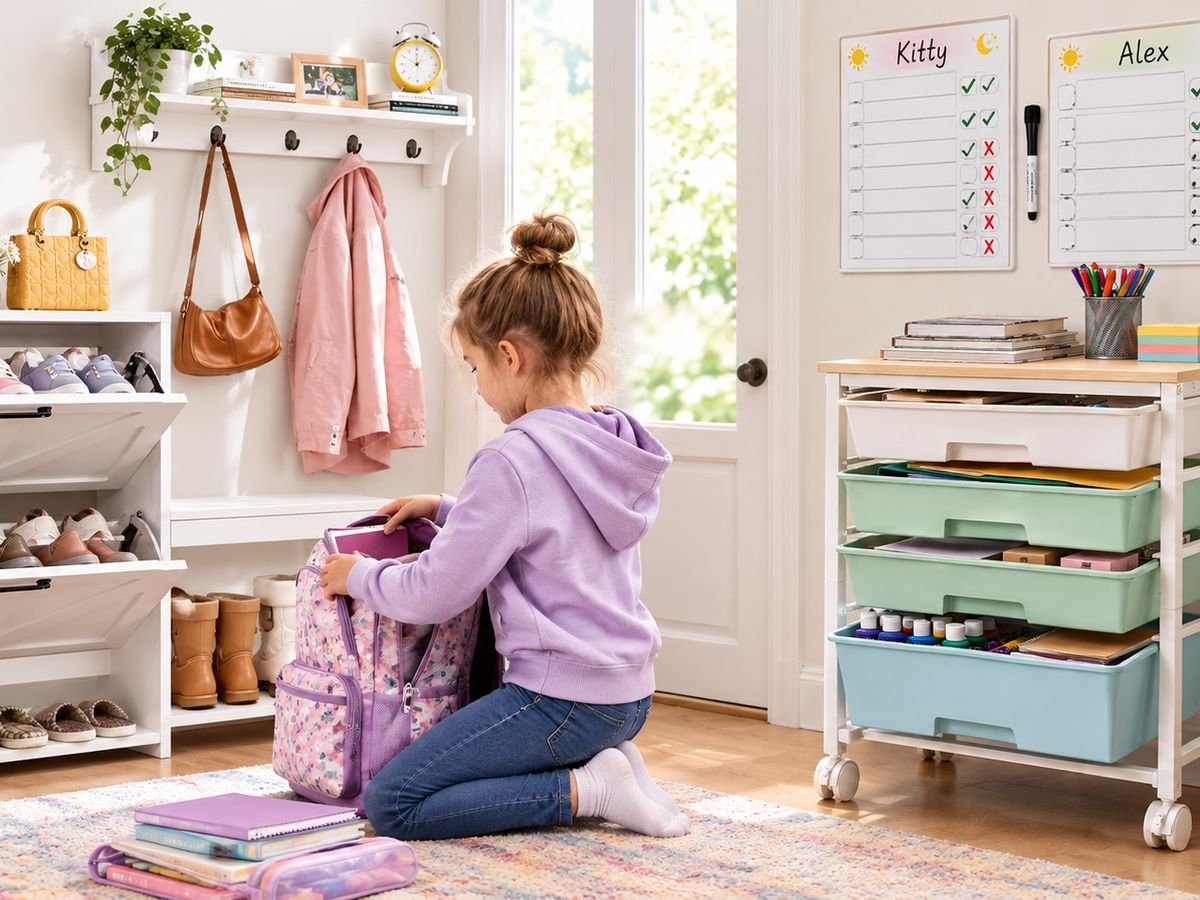
An entryway shelf with hooks and a shoe bench gave every single thing a home the moment my kids stepped inside. Backpacks hang, shoes go in the cubby, and coats don’t end up on the couch anymore. The hooks are low enough that even my youngest twin can hang her own stuff up without asking me for help.
I went with a model that’s about three feet wide, which fits perfectly against the wall right inside our back door. It runs around fifty dollars, and honestly I’d have paid double for how much floor space it freed up alone. The bench part doubles as somewhere to actually sit and take shoes off instead of hopping around on one foot in the hallway.
- The win: No more tripping over backpacks in the kitchen at dinner time
- The time-save: Zero minutes spent hunting for a missing shoe before we leave the house the next morning
- The habit-builder: Kids hang their own stuff up because it’s actually easy to reach
Fair warning: the bench only holds so many pairs of shoes, so if you’ve got four or more kids you might need a second one or a wider model. For our family of three kids it’s been plenty.
That landing zone solved the “stuff everywhere” problem, but it didn’t solve the bigger issue. My kids still had no idea what to actually do once their shoes were off, which meant I was still the one narrating every single step of the afternoon.
They’d stand in the kitchen looking at me, waiting to be told what came next, every single day like it was the first time. That’s a lot of mental load for one mom to carry on repeat.
The Sanity-Saver: A Routine They Can Actually See
The After-School Reset Hero: Here’s the thing nobody tells you. Kids don’t ignore your instructions because they’re being difficult. They ignore them because they can’t hold five verbal steps in their head at 3:30pm after a full day at school.
A magnetic dry erase routine board changed that overnight. I wrote out the actual sequence, snack, homework, chores, free time, and hung it at kid height in the kitchen. Now when someone asks “what do I do next,” I just point at the board instead of repeating myself for the tenth time.
Ours is a simple magnetic board, about sixteen by twenty inches, and it cost less than a fast food dinner for our family. I like that it’s magnetic because I can move little icons around instead of rewriting the whole thing every day. It lives right next to the fridge, which turns out to be the one spot every kid in this house walks past constantly.
- The relief: I’m no longer the human alarm clock for every single transition
- The flow-maker: Kids move through the sequence because they can see it, not because I’m nagging
- The payoff: Afternoons feel calmer because nobody is confused about what comes next
One thing to know: the marker smudges if little hands touch it right after writing, so give it a minute to dry before anyone starts pointing at it. Not a dealbreaker, just good to know.
So now everyone knows the sequence starts with homework. But knowing the plan and actually being able to execute it are two very different things when nobody can find a pencil.
The Homework Flow Maker
Why it makes afternoons easier: This is the one that shocked me the most. My middle-schooler would sit down to do homework and then get up four separate times, once for a pencil, once for a ruler, once for the glue stick that’s apparently always missing.
A rolling storage cart with drawers ended that entirely. I stocked it with pencils, scissors, glue, a ruler, and loose leaf paper, and now it parks right next to wherever homework is happening that day. Nobody gets up mid-assignment anymore, which means homework that used to drag on for an hour now wraps up in twenty minutes.
Mine has three stacked drawers and a handle on top, so it rolls from the kitchen table to the living room depending on where everyone’s actually sitting that day. It ran me around forty five dollars, which felt like a lot for what’s basically a plastic cart until I did the math on how many hours of stalling it saved us in the first week alone.
- The time-save: Homework sessions that used to take an hour now take twenty minutes
- The game-changer for focus time: Fewer interruptions means fewer chances to get distracted and wander off
- The win: One cart works for all three of my kids since it rolls to whoever needs it
Skip this if: you’re tight on storage space, since it does take up a bit of floor room. For us it tucks into a closet when it’s not in use, so it hasn’t been an issue.
With homework actually flowing instead of stalling out, the next crisis point was obvious. Hungry kids do not do homework well, and snack time had turned into its own daily negotiation.
The After-School Hunger Saver
The Sync Factor: My kids come off the bus starving every single day, no exceptions. For a while that meant a constant stream of “can I have this” questions while I was still trying to get my shoes off.
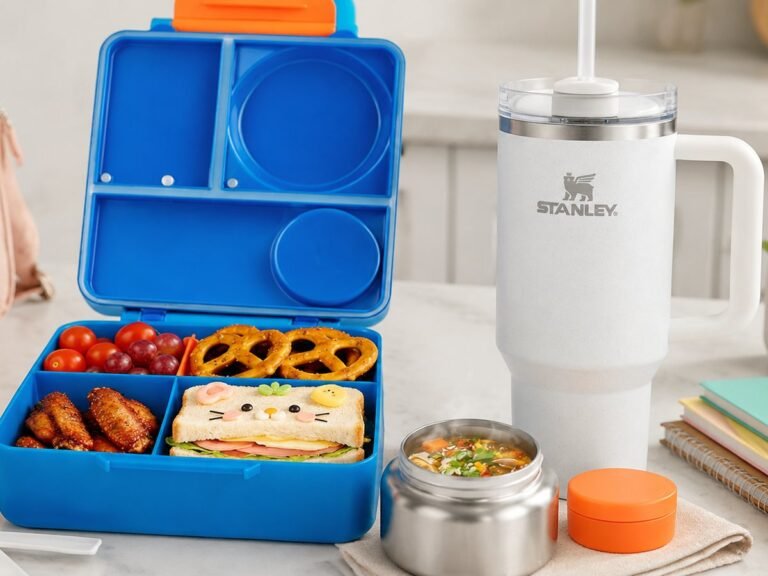
Stackable clear pantry bins with lids fixed that fast. I filled a few with pre-approved snacks, granola bars, pretzels, fruit snacks, and now my kids can see exactly what’s available and grab something themselves. No permission needed, no guessing what’s actually in stock.
I picked up a set of six, and they stack two rows high on our pantry shelf without wasting any space. They ran about thirty dollars for the whole set, which is honestly less than what I used to spend replacing the flimsy bags that snacks come in. My twins can lift the lids themselves, which was the whole point of switching away from a high shelf they couldn’t reach.
- The relief: No more twenty questions about what snacks are allowed
- The flow-maker: Kids feed themselves the second they’re hungry, which means less crankiness before homework starts
- The habit-builder: They’re learning to make their own choices from what’s available, which feels like a genuine skill
The honest trade-off: the bins need refilling more often than I expected, since clear containers make it obvious the second something’s running low. Honestly that’s a small price for how much easier snack time got.
Snacks are handled and homework is flowing, but there’s one battle I hadn’t cracked yet. The screen time cutoff was still turning into a full blown standoff every single afternoon.
Every parent knows this fight. You give the warning, you give the second warning, and by the time you actually turn the screen off somebody’s in tears over it.
The Screen Time Game-Changer
The Routine Payoff: Let’s be honest, the “five more minutes” negotiation used to happen every single day, and it always ended with someone upset. Telling a kid to stop looking at a screen feels personal to them, even when it isn’t.
A visual countdown timer took me completely out of that fight. I set it for whatever time is left, and my kids can see the time shrinking in real time instead of just hearing me announce it’s almost over. The timer becomes the bad guy, not me, and honestly that alone has been worth it.
Ours sits on the kitchen counter where everyone can see it, and it’s simple enough that even my youngest twin understands the red section shrinking means time’s almost up. It cost about twenty dollars, no app, no charging cord, just a dial you twist. I was skeptical something this simple could actually work, but the visual piece makes all the difference for kids who can’t read a clock yet.
- The win: Screen time transitions with way less arguing since the timer does the talking
- The time-save: I’m not standing there repeating “five more minutes” on a loop
- The game-changer for homework focus: It doubles as a visual work timer, so even my middle-schooler uses it to stay on task
Real talk: it’s an extra gadget to keep track of and the battery does need the occasional swap. Worth it for the sheer number of arguments it’s ended in our house.
The screen time fights are gone, which freed up a huge amount of my own energy. The last piece was making sure my kids could actually track the whole routine themselves, not just the fun parts.
The Habit-Builder: Chores That Stick
Why This Earns Its Spot: All five pieces above work great, but I still found myself reminding everyone about the small stuff, feed the dog, pack tomorrow’s lunch, put your backpack back on the hook. The routine board covers the big sequence, but the little responsibilities kept slipping through.
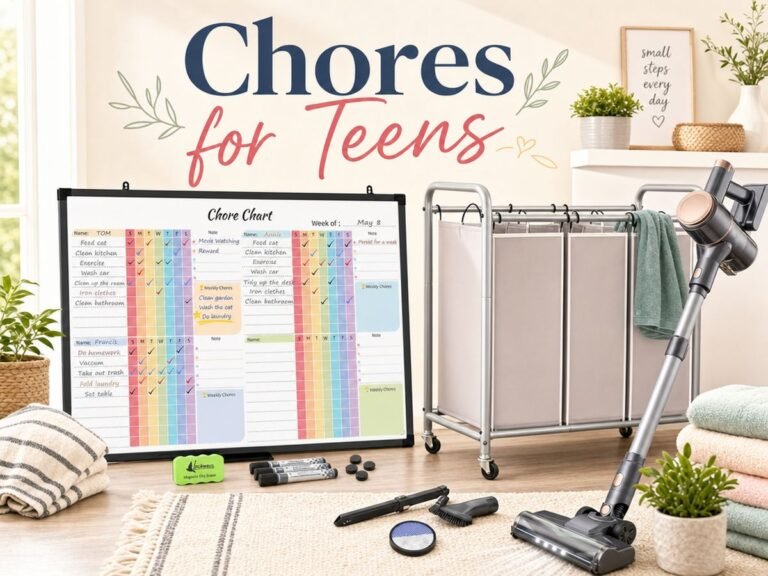
A magnetic responsibility chart gave every kid their own column with movable pieces they flip or move once a task is done. My twins genuinely compete to finish their side first now, which is not something I expected from a chore chart. It turned the whole after school routine into something they own, not something I enforce.
The wood one we have hangs on the pantry door and has a magnetic piece for each task that flips from “to do” to “done.” It ran about thirty five dollars, and I’ve genuinely gotten more out of it than plenty of things that cost triple that. My middle-schooler thinks he’s too old for it, but I’ve caught him flipping his pieces anyway, so I’m calling that a win.
- The habit-builder: Kids track their own responsibilities without me listing them out loud
- The relief: I’ve stopped being the one who remembers every single small task
- The payoff: The routine finally runs even on the days I’m not hovering over every step
Skip this if: you’ve got a kid who genuinely doesn’t respond to visual reward systems, since a few kids need a different motivation style entirely. Mine have been all in from week one.
The Payoff: Calm Afternoons, For Real This Time
Remember that after school blur I told you about? Backpacks on the floor, nobody moving toward homework, me repeating the same five steps until I lost my voice. That’s not our afternoon anymore.
The landing zone means backpacks and shoes have a home. The routine board means nobody needs me to narrate the sequence. The homework cart means my middle-schooler stops interrupting his own assignment to hunt for a pencil. The snack bins mean hungry kids feed themselves before anyone gets cranky. The screen time timer means transitions happen without a single standoff. And the responsibility chart means the little stuff gets done without me chasing anyone down.
Put together, these six pieces turned a daily fight into an actual system, and honestly, that’s the whole point. My afternoons feel predictable now. I’m not the family’s alarm clock, referee, and search party all rolled into one anymore. There’s real peace in that, and I promise you can build the same thing in your house.
None of these six things are complicated or expensive on their own. A hook, a whiteboard, a rolling cart, a few bins, a timer, a magnet chart. What changed everything was putting them together as one connected system instead of buying random organization products and hoping for the best.
I’m not saying our afternoons are perfect. Someone still forgets their homework folder occasionally, and my youngest twin still tries to negotiate for “just one more show.” But the constant chaos, the part that used to leave me exhausted by 5pm every single day, that part is genuinely gone.
If you’re in the thick of the After School Blur right now, start with just one piece. Pick whichever problem feels the loudest in your house today, the backpack pileup, the homework stalling, the screen time meltdown, and fix that one thing first. The rest of the system can build itself one afternoon at a time.
If you’re still figuring out mornings too, our post on how we automate our school morning routine pairs perfectly with this one. And once the after school snack questions are handled by the bins, you might want fresh ideas over in our toddler snack ideas roundup for the littlest ones in the house.
You’ve got this, mama! Drop a comment and tell me what part of your after school routine is the hardest right now. I’d love to help you troubleshoot it.
Don’t forget to pin this article!